FDA Allergen Labeling Requirements
Allergen labeling is the most strictly enforced part of a food label — and undeclared allergens are among the top causes of FDA recalls. Here's exactly what to declare, how, and where.
Key Takeaways
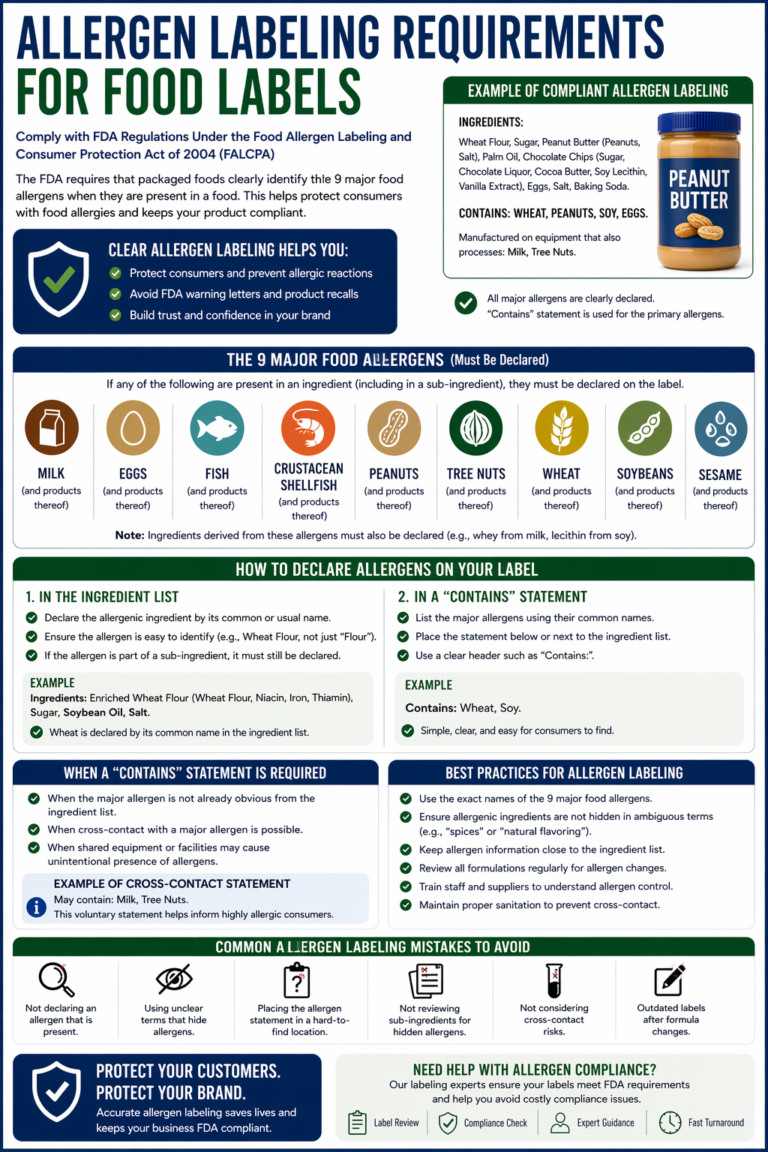
- 9 major allergens: milk, eggs, fish, Crustacean shellfish, tree nuts, peanuts, wheat, soybeans, sesame — sesame added by the FASTER Act on Jan 1, 2023.
- Declare the source two ways: within the ingredient list (e.g., "whey (milk)") or a "Contains" statement listing every allergen present.
- Be specific: name the specific tree nut, fish species, and Crustacean shellfish — not generic "tree nuts" or "fish."
- No threshold: any amount present as an ingredient is declarable — including allergens in flavors, colors, and sub-ingredients.
- Mollusks (clams, oysters, scallops) are not major allergens; only Crustacean shellfish are.
- "Milk" now includes cow, goat, sheep, and other ruminant milk under FDA's updated guidance.
- "May contain" advisory statements are voluntary — never a substitute for a required declaration.
The 9 Major Allergens — and the Naming Rules
FALCPA established the first eight in 2004; the FASTER Act added sesame, effective January 1, 2023. Several carry naming nuances that trip up labels:
| Allergen | Naming rule / nuance | On the label |
|---|---|---|
| Fish | Name the specific species — "fish" alone isn't enough. | cod; salmon; tuna |
| Crustacean shellfish | Name the specific species. Mollusks (clams, oysters, scallops) are not major allergens. | shrimp; crab; lobster |
| Tree nuts | Name the specific nut — not "tree nuts" collectively. | almonds; walnuts; pecans |
| Milk | Now includes cow, goat, sheep, and other ruminant milk (updated FDA guidance). | milk; whey (milk) |
| Wheat | The wheat allergen is not the same as gluten-free status (separate rule). | wheat; semolina (wheat) |
| Sesame | 9th allergen since Jan 1, 2023 — often missing on older labels. | sesame |
Two Methods: In the List, or a "Contains" Statement
1. Within the ingredient list
The source appears in the ingredient's common name, or in a parenthetical right after it.
2. A "Contains" statement
Immediately after or adjacent to the list, in type at least as large as the ingredient list, naming every allergen present.
Hidden Allergens & Derivatives
The hardest allergens to catch are the ones whose names don't reveal the source. FALCPA applies to flavors, colors, and incidental additives too — so these are common hiding places:
| Ingredient | Hidden allergen |
|---|---|
casein, caseinate, whey | Milk |
lecithin (often) | Soy |
semolina, durum, farina | Wheat |
albumin | Egg |
natural flavor / spice blends | Any — must be traced to the source |
What's Exempt — and What Isn't
Highly refined oils
A highly refined oil derived from a major allergen is exempt from the allergen definition — it doesn't trigger a "Contains" declaration. But the oil's source is still named in the ingredient list (e.g., soybean oil). A non-refined allergen oil must be declared as an allergen.
Petition & notification process
A manufacturer can seek an exemption for an ingredient shown not to contain allergenic protein (notification) or not to cause an allergic response (petition). FDA maintains a public inventory of accepted notifications.
No threshold
FDA has set no minimum level. Any amount of a major allergen present as an ingredient must be declared — there is no "de minimis" for intentional ingredients.
Cross-Contact vs. Declaration — and "Gluten-Free"
How to Make Your Allergen Labeling Compliant
Map every allergen in the formulation
Trace all ingredients, flavors, colors, and sub-ingredients — including compound ingredients — for any of the 9 allergens.
Name each by its required source
Specific tree nut, specific fish species, specific Crustacean shellfish — never generic terms.
Choose a declaration method
Sources in the ingredient list, or a "Contains" statement that names every allergen present.
Format the "Contains" statement
Immediately after or adjacent to the list, in type at least the same size.
Handle cross-contact honestly
Control it in your food safety plan; use advisory statements only for genuine risk, never as a substitute.
Re-verify after every change
Any supplier or formulation change can introduce an allergen — recheck the declaration before shipping.
Don't Let a Hidden Allergen Trigger a Recall
The allergen failures that cause recalls are exactly the ones a quick glance misses — a source buried in a flavor, a missing species name, a supplier change no one caught. FDA Registration Assistance traces your full formulation for every allergen source, verifies your ingredient list and "Contains" statement, and returns the corrections before you print or ship.
Contact us at info@fdaregistrationassistance.com or call +1 (928) 275-8333. 15+ years of FDA regulatory experience across 135+ countries.
Frequently Asked Questions — FDA Allergen Labeling
1. What are the FDA allergen labeling requirements?
Under FALCPA (section 403(w) of the FD&C Act), any packaged food with one of the 9 major allergens must declare that allergen's food source — in the ingredient list or a "Contains" statement — using the specific source name. It applies to allergens hidden in flavors, colors, and sub-ingredients, and there's no threshold: any amount present as an ingredient must be declared.
2. What are the 9 major food allergens?
Milk, eggs, fish, Crustacean shellfish, tree nuts, peanuts, wheat, soybeans, and sesame. The first 8 came from FALCPA (2004); sesame was added by the FASTER Act, effective January 1, 2023.
3. Is sesame now a required allergen?
Yes — the 9th major allergen since January 1, 2023. It must be declared wherever present, including inside spice blends and flavorings. Pre-2023 labels frequently omit it.
4. How must allergens be declared?
Two ways: (1) in the ingredient list, via the ingredient's common name or a parenthetical ("whey (milk)," "lecithin (soy)"); or (2) a "Contains" statement after the list ("Contains: Milk, Soy, Wheat") that names every allergen present.
5. Do I need both an ingredient list and a "Contains" statement?
No — either method works. Many use both for clarity, but a "Contains" statement isn't mandatory. If you use one, it must list all major allergens and be in type at least as large as the ingredient list.
6. Do I have to name the specific tree nut, fish, or shellfish?
Yes. Specific nut ("almonds"), specific fish species ("cod"), and specific Crustacean shellfish ("shrimp"). Generic "tree nuts," "fish," or "shellfish" alone isn't enough.
7. Are mollusks like clams and oysters major allergens?
No. Only Crustacean shellfish (crab, lobster, shrimp) are major allergens. Molluscan shellfish — clams, oysters, mussels, scallops — are not, though they may be declared voluntarily.
8. Is "milk" limited to cow's milk?
No longer. FDA's updated guidance expanded "milk" to include cow, goat, sheep, and other ruminant milk. Goat or sheep milk is treated as the "milk" allergen.
9. What are hidden allergens and derivatives?
Ingredients derived from an allergen whose name doesn't reveal it — casein/whey (milk), lecithin (soy), semolina (wheat), albumin (egg). The source must still be declared, and FALCPA covers flavors, colors, and incidental additives too.
10. Are there any allergen exemptions?
A narrow set: highly refined oils from a major allergen (and ingredients from them) are exempt, and a petition/notification process can exempt an ingredient shown not to cause a reaction or not to contain allergenic protein. Raw fruits and vegetables are also outside FALCPA.
11. Are highly refined oils exempt, and do I still name the source?
The oil is exempt from the allergen definition, so it doesn't trigger a "Contains" declaration — but the oil's source is still named in the ingredient list (e.g., "soybean oil"). A non-refined allergen oil must be declared as an allergen.
12. Is there a minimum amount that must be declared?
No. FDA has set no threshold. Any amount of a major allergen present as an ingredient must be declared. That's separate from cross-contact, which is managed through your food safety plan.
13. What is cross-contact, and are "may contain" statements required?
Cross-contact is the unintentional introduction of an allergen in manufacturing. "May contain" advisories are voluntary, must not mislead, and never substitute for a required declaration. Cross-contact must be controlled, not just disclosed.
14. How should the "Contains" statement be formatted and placed?
Immediately after or adjacent to the ingredient list, in type at least as large as the ingredient list, naming all allergens present ("Contains: Milk, Egg, Wheat, Soy").
15. Is "gluten-free" the same as declaring wheat?
No. Declaring wheat is mandatory when present. "Gluten-free" is a voluntary claim allowed only under 20 ppm gluten. A product can contain wheat and must declare it, while a gluten-free claim is about the 20 ppm limit.
16. What happens if I fail to declare an allergen?
The food is misbranded, and FDA can pursue recall, import refusal, and seizure, plus civil or criminal penalties. Undeclared allergens are a leading recall cause and a high-risk, Class I concern.
17. Why are undeclared allergens such a common recall cause?
Most trace to a change the label missed — a supplier or formulation change, the wrong label applied, an allergen in a flavor, or an older label without sesame. Re-verifying after every change is the best safeguard.
18. Do flavors, colors, and additives count?
Yes. FALCPA applies to any ingredient containing a major allergen, including flavorings, colorings, and incidental additives. An allergen inside a "natural flavor" still must be declared.
19. Which products are outside FALCPA?
Meat/poultry/egg products (USDA FSIS), alcoholic beverages (TTB), raw agricultural commodities, highly refined oils, drugs, cosmetics, and most non-prepackaged retail/foodservice foods. FALCPA covers FDA-regulated packaged foods, including supplements.
20. Do imported products follow the same rules?
Yes — and the declaration must be in English (plus any other language on the label). International labels often miss specific-source naming or omit sesame and must be revised before import.
21. Can incorrect allergen labeling delay my shipment?
Yes. An allergen problem makes the product misbranded, which can trigger detention or refusal at the port and recall once in commerce. Allergen violations are among the fastest to draw enforcement.
22. Can I use technical ingredient names for allergens?
You may, but the allergen source must still be identified — "sodium caseinate" tied to milk, "semolina" to wheat — via a parenthetical or a "Contains" statement. The technical name alone isn't enough.
23. How long does an allergen label review take?
Typically 2–3 business days, depending on formulation complexity and how many flavors and sub-ingredients must be traced for hidden allergens.
24. Do I need professional help with allergen labeling?
It's strongly advisable. Allergen rules are strictly enforced and the highest-risk part of a label, and the hardest failures — a hidden allergen, a missing species name, a supplier change — are exactly what a professional review catches.
25. How does FDA Registration Assistance help?
FDA Registration Assistance traces your full formulation for all major allergen sources, verifies the declaration method and "Contains" statement, reviews cross-contact advisory language, and returns the corrections needed — supporting foreign manufacturers and U.S. importers.
26. How do I get my allergen labeling reviewed?
Contact FDA Registration Assistance at info@fdaregistrationassistance.com or call +1 (928) 275-8333. Send your full formulation (including flavorings and sub-ingredients) and label artwork for review against FALCPA before you print or ship.