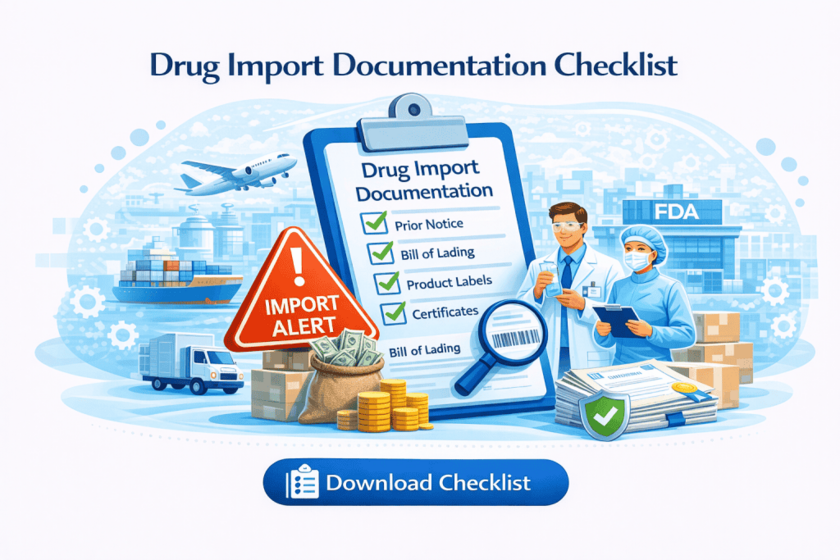
Drug Import Documentation Checklist
The full checklist of what FDA needs to clear an imported drug — and why a registered facility alone won't get your shipment released.
Key Takeaways
- Registration ≠ approval — a registered facility doesn't make the drug admissible.
- Establishment registered + drug listed (NDC) — both under 21 CFR Part 207.
- An approval pathway is required — NDA/ANDA (Rx) or OTC monograph.
- cGMP + compliant labeling — or the drug is adulterated / misbranded.
- Foreign facilities need a U.S. Agent — and must list their U.S. importers.
- Entry data must match FDA records — product code + Affirmation of Compliance codes.
What FDA Needs to Admit an Imported Drug
| Document / data element | What it establishes | Basis |
|---|---|---|
| Establishment registration (FEI) | The facility is known to FDA and in the supply chain | 21 CFR Part 207 (annual, Oct–Dec) |
| Drug listing + NDC | The product is listed and identified (10-digit NDC) | 21 CFR 207.41 (SPL via DRLM) |
| Approval pathway | The drug is legally marketable | NDA/ANDA (Rx) or OTC monograph (505G) |
| cGMP compliance | Made under quality controls (not adulterated) | 21 CFR Parts 210 & 211 |
| Compliant labeling | Not misbranded | Drug Facts (201.66) / "Rx only" + PI (201.57) |
| U.S. Agent | Foreign facility's FDA contact | 21 CFR 207.69 |
| Entry data (ACE) | Admissibility info to FDA/CBP | Product code + Affirmation of Compliance codes |
| Importer of record | Legal responsibility for the entry | Listed as a known importer |
| Commercial docs + CoA | Shipment identity & lot quality | Invoice, packing list, bill of lading, Certificate of Analysis |
| DUNS number | Verifiable facility identity | Required for registration |
| DEA registration + permit | Controlled-substance authority (if applicable) | Separate DEA requirement |
Registration Is Not Approval
It's easy to assume a registered facility means an admissible drug. It doesn't. Establishment registration (21 CFR Part 207) simply tells FDA your facility exists, has an FEI number, and is identified in the supply chain. Drug approval is a separate, product-level status where FDA has evaluated safety, efficacy, manufacturing, and labeling for that specific product.
Prescription vs OTC — What Differs
| Prescription (Rx) | OTC (non-prescription) | |
|---|---|---|
| Registration + listing/NDC | Required | Required |
| Approval pathway | NDA / ANDA (or BLA for biologics) | OTC monograph (505G), or own approval |
| Labeling | "Rx only" + prescribing info (201.57) | Drug Facts panel (201.66) |
| cGMP (210/211) | Required | Required |
Why Drug Shipments Get Detained
- Establishment not registered — or the annual registration lapsed (a precondition to admissibility)
- Listing missing or inactive — no valid NDC on file
- No approval pathway — unapproved new drug, or an OTC that doesn't meet its monograph
- Misbranding — non-compliant Drug Facts or Rx labeling
- cGMP problems — the drug is treated as adulterated
- Entry-data mismatch — Affirmation of Compliance codes, product code, or manufacturer don't match FDA records
Get Your Drug Import Documentation Right
FDA Registration Assistance builds and verifies the full structure behind the entry — establishment registration and DUNS, drug listing and NDC in SPL, U.S. Agent designation, labeling review, confirmation of the approval pathway, and alignment of the entry data (product code and Affirmation of Compliance codes) — so shipments are admissible on arrival. We also assist with detention and Import Alert resolution.
Contact us at info@fdaregistrationassistance.com or call +1 (928) 275-8333 for a scope and quote for your products. Trusted by companies across 135+ countries, with 15+ years of experience.
Frequently Asked Questions — Drug Import Documentation
1. What documentation does FDA review when a drug is imported?
FDA reviews the electronic entry transmitted through CBP's ACE system to decide admissibility: the manufacturer/establishment, the importer, product identity, the regulatory pathway, labeling, and the Affirmation of Compliance codes. Behind those data elements sit the underlying requirements — establishment registration, an active drug listing/NDC, an approval pathway (NDA/ANDA or OTC monograph), cGMP, and compliant labeling. If the entry data can't be verified against FDA records, the shipment is detained.
2. Is drug establishment registration alone enough to import a drug?
No — this is the single most important point. Registering the establishment (21 CFR Part 207) tells FDA the facility exists and is in the supply chain; it does not make the drug approved or admissible. A prescription drug needs both a registered facility and an approved NDA or ANDA. An OTC drug needs registration plus compliance with the applicable OTC monograph (or its own approval). Registration and approval are two separate things, and importing needs both.
3. What is the drug listing and NDC?
Every drug marketed in the U.S. must be listed with FDA (21 CFR 207.41) and assigned a National Drug Code (NDC) — a unique 10-digit identifier. Listing is submitted electronically in Structured Product Labeling (SPL) format, and the labeler code is the first segment of the NDC. The listing must be active at the time of import; a missing or inactive listing is a common reason drug entries are held.
4. Do foreign drug manufacturers need a U.S. Agent?
Yes. Foreign drug establishments must designate a U.S. Agent (21 CFR 207.69) as part of registration, and must also list their known U.S. importers. Without a valid registration — which requires the U.S. Agent — a foreign establishment cannot lawfully ship drugs to the United States, and its shipments are refused.
5. How is a drug import entry filed?
The import entry is filed with U.S. Customs and Border Protection, and FDA-specific data is transmitted electronically through CBP's Automated Commercial Environment (ACE) — the single window the two agencies share. Under 21 CFR Part 1 Subpart D, the entry must carry the data elements FDA needs to determine admissibility, including Affirmation of Compliance (A of C) codes such as the drug registration number and the NDC. A licensed customs broker typically files this at entry.
6. What are Affirmation of Compliance codes?
Affirmation of Compliance (A of C) codes are data elements in the electronic entry that assert specific regulatory facts to FDA — for drugs, key ones convey the drug establishment registration number and the product's NDC/listing. Accurate A of C codes that match FDA's records are what let an entry clear automatically; mismatches trigger review, detention, or a request for documentation.
7. What labeling must an imported drug carry?
Drug labels must comply with 21 CFR Part 201 and not be false or misleading. OTC (non-prescription) drugs need a standard Drug Facts panel (21 CFR 201.66). Prescription drugs must state "Rx only" and carry FDA-compliant prescribing information (21 CFR 201.57). The NDC generally appears on the label as well. Non-compliant labeling makes the product misbranded and is a frequent basis for detention.
8. What is cGMP and does it matter at import?
Current Good Manufacturing Practice (cGMP) under 21 CFR Parts 210 and 211 sets the quality standards for how drugs are manufactured. A drug that isn't made under cGMP is considered adulterated — and FDA can detain or refuse it, or place the establishment on Import Alert. cGMP compliance underlies the whole import: it's what a Certificate of Analysis and the manufacturer's quality records support.
9. Why are most drug shipments detained?
The usual causes: the establishment isn't registered (or the registration lapsed), the drug listing is missing or inactive, there's no valid approval pathway (unapproved new drug, or an OTC that doesn't meet its monograph), the labeling is non-compliant (misbranding), cGMP problems, or the entry data (A of C codes, product code, manufacturer) doesn't match FDA records. A history of non-compliant entries increases scrutiny on future shipments.
10. How is importing a prescription drug different from an OTC drug?
Both need a registered establishment and an active listing/NDC. The difference is the pathway and labeling: a prescription drug needs an FDA-approved NDA or ANDA (or a BLA for biologics) and "Rx only" labeling with prescribing information; an OTC drug typically relies on compliance with an OTC monograph (section 505G) and carries a Drug Facts panel. Getting the pathway right — and declaring it correctly at entry — is essential.
11. Who is legally responsible for a compliant drug entry?
The importer of record is legally responsible for ensuring the product meets all U.S. requirements at the time of entry. If the documentation is incomplete or inaccurate, the shipment is held under the importer's name. Foreign establishments must also list their known importers in their registration, so the importer and establishment records need to align.
12. Is a Certificate of Analysis required?
A Certificate of Analysis (CoA) documents that the specific lot meets its specifications, and it's a standard part of a defensible drug import file. While the entry decision turns on the regulatory data elements, a CoA (and the underlying batch records) supports product identity and quality — and is often exactly what FDA asks for if a shipment is questioned or detained.
13. How often does drug establishment registration renew?
Drug establishment registration renews annually, during October 1 – December 31 each year (this differs from food facility registration, which is biennial). Drug listings must also be kept current, with updates submitted when information changes. A lapsed registration or outdated listing can cause every subsequent shipment to be held, so keeping both current is essential.
14. What about controlled substances?
Controlled substances carry an additional layer beyond FDA: the drug's DEA schedule is part of the listing, and importing a controlled substance also requires DEA registration and the appropriate DEA import permit/declaration. That's a separate authority from FDA admissibility, and both must be satisfied. We flag when a product is scheduled so the DEA steps aren't missed.
15. Does FDA "approve" the import or the shipment?
FDA makes an admissibility determination on each entry — it doesn't "approve" shipments. What matters is whether the drug (as declared) has a valid regulatory status and the entry data verifies against FDA records. Drug approval (NDA/ANDA/monograph) is a separate, product-level status that must already be in place; the entry review checks that everything lines up so the shipment can be released.
16. What is DUNS and is it needed?
A DUNS (Data Universal Numbering System) number from Dun & Bradstreet is used to identify the establishment and is required as part of drug establishment registration. It ties the facility to a verifiable identity in FDA's system. Obtaining or confirming the DUNS is one of the first steps when setting up a foreign or domestic drug establishment for import.
17. How does FDA Registration Assistance help with drug import documentation?
We build and verify the whole compliance structure behind the entry: drug establishment registration and DUNS, drug listing and NDC in SPL, U.S. Agent designation, labeling review (Drug Facts or Rx labeling), confirmation of the approval pathway, and alignment of the entry data — product code and Affirmation of Compliance codes — so the shipment is admissible on arrival. We also assist with Import Alert / detention resolution. Contact info@fdaregistrationassistance.com or +1 (928) 275-8333 for a scope and quote for your products.