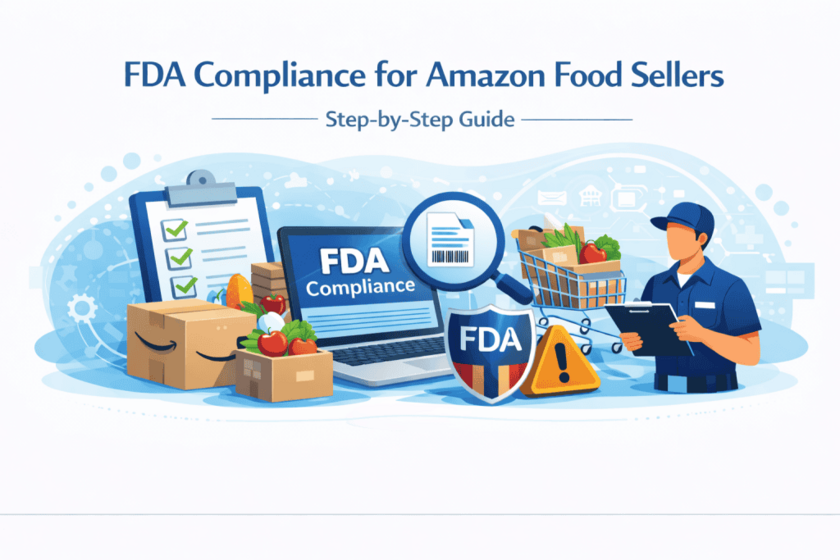
FDA Compliance for Amazon Food Sellers
This guide explains the three-party compliance structure for Amazon private label sellers, what triggers Amazon compliance holds, why listing content is FDA labeling, the drug claim trap for Amazon food and supplement sellers, and what each compliance role requires.
Who Is Responsible for What — Amazon Private Label Food Supply Chain
Most Amazon private label food sellers occupy three distinct FDA compliance roles simultaneously. Understanding which role you occupy — and what each requires — is the foundation of Amazon food compliance:
What Triggers Amazon Compliance Holds for Food Sellers
Amazon compliance holds for food sellers are triggered by both Amazon’s internal Consumer Product Compliance (CPC) team and by FDA regulatory action. These are separate pathways — both can suspend your listing or block your inventory:
Why Amazon Listing Content Is FDA Labeling — and the Drug Claim Trap
Drug Claims That Destroy Amazon Food Listings
A food product becomes an unapproved new drug under 21 U.S.C. § 321(g) if intended to treat or prevent a disease — even if the claim appears only in the Amazon listing and not on the physical label. Claims that trigger this:
“Reduces inflammation” · “Fights cancer” · “Lowers blood pressure” · “Treats arthritis” · “Prevents diabetes” · “Cures insomnia” · “Kills viruses and bacteria” · “Detoxifies the liver”
FDA actively monitors Amazon listings for drug claims and has issued Warning Letters to Amazon sellers based solely on listing content.
What Listing Content Must Match the Label
Amazon also requires — and FDA expects — that listing content is consistent with the physical product label:
✓ Ingredient claims in listing must reflect actual ingredients
✓ “Gluten-free” in listing requires product meets <20 ppm standard (21 CFR 101.91)
✓ “Organic” requires USDA NOP certification
✓ Product images must show the actual label — not a different version
✓ Claims about specific ingredients must match the label and Nutrition Facts panel
See the full Amazon FBA food label guide for complete labeling requirements.
What Most Amazon Food Sellers Get Wrong
Wrong Nutrition Facts Serving Size
Foreign manufacturers use non-U.S. serving sizes. The FDA RACC under 21 CFR Part 101.12 is mandatory — not the manufacturer’s preferred portion. A wrong serving size makes the entire Nutrition Facts panel non-compliant. This is the #1 labeling error for Amazon sellers importing from overseas.
Missing Sesame Allergen Declaration
Sesame became the 9th major U.S. allergen under the FASTER Act effective January 1, 2023. Any Amazon food product containing sesame seeds, sesame oil, tahini, or sesame paste must declare sesame on the physical label. Missing sesame = misbranded food = FDA violation and Amazon account risk.
No FSVP as Importer of Record
Amazon sellers who are the importer of record for their food products are FSVP obligors under 21 CFR Part 1 Subpart L. Most don’t have a written FSVP program. FDA can request FSVP records within 24 hours for domestic records. A missing FSVP is a Warning Letter and Import Alert risk.
Unverified Manufacturer Registration
The manufacturer’s FDA Food Facility Registration must be current. If the registration expired or was never filed, every shipment is subject to detention. Amazon sellers should verify manufacturer registration status before each major shipment — especially around the Biennial Renewal period.
Pre-2020 Nutrition Facts Format
Labels designed before 2020 or for non-U.S. markets often use the outdated Nutrition Facts format — showing Calories from Fat, missing Added Sugars, with outdated % Daily Values. The 2020 FDA format is mandatory for all products sold in the United States including on Amazon.
Drug Claims in Listing Bullets
Sellers add disease prevention and treatment claims in Amazon bullet points that they would never put on the physical label — not realizing these bullet points are FDA labeling. Claims like “reduces inflammation,” “boosts immunity,” or “supports healthy blood sugar” (framed as disease treatment) trigger FDA Warning Letters and Amazon listing removal.
Ready to Get Your Amazon Food Business Fully FDA-Compliant?
FDA Registration Assistance helps Amazon food sellers confirm their specific FDA obligations, verify and obtain manufacturer Food Facility Registration documentation, build FSVP programs, review food labels and Amazon listing content, and respond to Amazon CPC compliance requests. 1,000+ clients. 135+ countries. 15+ years of FDA regulatory experience.
Contact us at info@fdaregistrationassistance.com or call +1 (928) 275-8333.
Frequently Asked Questions — FDA Compliance for Amazon Food Sellers
1. What FDA compliance is required for Amazon food sellers?
Depends on your role. Manufacturer: facility registration under 21 CFR Part 1 Subpart H. Importer: FSVP under 21 CFR Part 1 Subpart L plus Prior Notice. Responsible firm on label: full labeling compliance under 21 CFR Part 101. Most Amazon private label sellers occupy all three roles simultaneously.
2. Does Amazon approval mean a food product is FDA compliant?
No. Amazon listing approval and FDA regulatory compliance are completely separate. Amazon listing approval means Amazon accepted the product into its marketplace based on Amazon’s own policies — it does not verify FDA registration, FSVP compliance, or label compliance. A product can be listed on Amazon and simultaneously be in violation of FDA regulations.
3. What is the three-party FDA compliance structure for Amazon private label sellers?
(1) The foreign manufacturer must register its FDA Food Facility and designate a U.S. Agent — the manufacturer’s obligation. (2) The Amazon seller, if they are the U.S. importer of record, must maintain FSVP for the foreign manufacturer under 21 CFR Part 1 Subpart L. (3) The Amazon seller, whose brand appears on the label, is the responsible firm for labeling compliance under 21 CFR Part 101.
4. What is FSVP and which Amazon sellers are responsible for it?
FSVP (Foreign Supplier Verification Program) under 21 CFR Part 1 Subpart L is required for U.S. importers of food. If the Amazon seller is the U.S. owner or consignee of food at time of U.S. entry (their name is on the CBP entry), they are the FSVP importer and must maintain a written FSVP program with hazard analysis, supplier verification activities, corrective actions, and 2-year recordkeeping for each foreign food supplier.
5. Does the Amazon seller or the manufacturer need FDA Food Facility Registration?
The manufacturer needs FDA Food Facility Registration — not the Amazon seller (unless the Amazon seller also manufactures food). The Amazon seller must verify as part of FSVP that the foreign manufacturer’s registration is current. An Amazon seller whose manufacturer’s facility is not FDA-registered cannot legally import that food.
6. Does Amazon FBA registration cover the food manufacturer’s FDA registration?
No. Amazon registers its FBA fulfillment centers for Amazon’s own holding activity. This has zero relevance to the foreign manufacturer’s FDA Food Facility Registration obligation. A manufacturer whose facility is not FDA-registered cannot legally export food to the United States regardless of Amazon FBA involvement.
7. What triggers Amazon compliance holds for food sellers?
Customer complaints mentioning illness or safety issues; drug claims in listing content; Amazon CPC compliance documentation requests; FDA port detention of incoming FBA shipments; and FDA recalls affecting FBA inventory. Both Amazon marketplace enforcement and FDA regulatory enforcement can independently suspend your listing or block your inventory.
8. Why is Amazon listing content considered FDA labeling?
FDA considers all labeling — not just the physical label — to include any written, printed, or graphic matter accompanying the food, including online sales listings, Amazon product detail pages (title, bullets, A+ content, description). Claims that convert a food into a drug can appear in Amazon listing content and still trigger FDA enforcement, even if the physical label is clean.
9. What drug claims in Amazon food listings trigger FDA enforcement?
Claims like “reduces inflammation,” “fights cancer,” “lowers blood pressure,” “treats arthritis,” “prevents diabetes,” “cures insomnia,” “kills viruses,” “detoxifies the liver” — in Amazon titles, bullets, or A+ content — can trigger FDA Warning Letters and Amazon listing removal. FDA actively monitors Amazon listings for drug claims under 21 U.S.C. § 321(g).
10. What is Prior Notice and do Amazon food importers need to file it?
FDA Prior Notice under 21 CFR Part 1 Subpart I is required before every food import: 8 hours for ocean, 4 hours for air, 2 hours for road. Amazon sellers who import food for FBA must file Prior Notice (typically through a customs broker) before each shipment. Prior Notice must include the correct FDA facility registration number and FDA product code. Errors cause port holds.
11. What FDA labeling requirements apply to food sold on Amazon?
Under 21 CFR Part 101: statement of identity on the PDP; net quantity in U.S. and metric units; Nutrition Facts in 2020 FDA format with correct RACC serving size; complete ingredient list; allergen declarations for all nine FALCPA/FASTER Act allergens including sesame (January 2023); manufacturer/distributor name and U.S. address. All required text in English. See the full Amazon food label guide.
12. What is a misbranded food and what happens to it on Amazon FBA?
A misbranded food under 21 U.S.C. § 343 has false or misleading labeling, missing required information, or unauthorized claims. Distributing a misbranded food is a prohibited act under 21 U.S.C. § 331. In the Amazon FBA context, FDA misbranding enforcement can result in recalls — requiring removal orders for all FBA inventory.
13. What is Amazon’s Consumer Product Compliance (CPC) program for food sellers?
Amazon’s CPC team verifies that products meet applicable safety and regulatory standards. For food sellers, CPC may request: FDA Food Facility Registration documentation for the manufacturer; FSVP compliance documentation; certificates of analysis; and labeling documentation. Failure to provide requested documentation results in listing suspension regardless of FDA action.
14. Do dietary supplement sellers on Amazon have additional FDA requirements?
Yes. Supplement manufacturers must comply with dietary supplement cGMPs under 21 CFR Part 111; supplement labels must carry a Supplement Facts panel; structure/function claims require FDA notification and the required disclaimer; disease claims are prohibited; and NDI notifications may be required for post-1994 ingredients. Dietary supplements face the strictest FDA enforcement posture and the highest Amazon CPC scrutiny among all food categories.
15. What happens if an Amazon seller’s food shipment is detained at a U.S. port?
The shipment cannot reach Amazon FBA until the detention is resolved. Common causes: expired or missing manufacturer FDA registration; Prior Notice errors; Import Alert listing. Resolving a detention requires providing documentation to FDA — which can take days to weeks. Inventory delays cause stockouts at FBA and hurt seller metrics.
16. Can a foreign Amazon food seller avoid FSVP if they use a U.S. distributor?
If a U.S. distributor is the actual importer of record — their name is on the CBP entry as U.S. owner or consignee — the FSVP obligation may shift to that distributor. However, the foreign manufacturer still needs its own FDA Food Facility Registration regardless of who imports. If the foreign seller arranges the import and is effectively the consignee, they remain the FSVP importer.
17. What is the sesame allergen requirement for Amazon food sellers?
Sesame is the 9th major U.S. allergen under the FASTER Act (effective January 1, 2023). Any Amazon food product containing sesame seeds, sesame oil, tahini, or sesame paste must declare sesame on the physical label — either in a “Contains: sesame” statement or bold parenthetical in the ingredient list. Missing sesame = misbranded food = FDA violation and Amazon listing risk.
18. What RACC serving size errors do Amazon food sellers commonly make?
Foreign manufacturers use non-U.S. serving sizes. The FDA RACC under 21 CFR Part 101.12 is mandatory. Examples: cookies = 30g; potato chips = 28g; peanut butter = 2 tbsp (32g); RTD beverages = 8 fl oz (240mL). A wrong serving size makes the entire Nutrition Facts panel non-compliant — the #1 labeling error for Amazon sellers importing from overseas.
19. What should an Amazon food seller do when they receive an Amazon compliance request?
Respond promptly. Typically requested: FDA Food Facility Registration document for the manufacturer; FSVP documentation; certificates of analysis; labeling documentation. Do not ignore — Amazon suspends listings or restricts selling privileges for non-response. If the request requires FDA documentation you don’t have, contact FDA Registration Assistance immediately for emergency support.
20. Do Amazon food sellers need to worry about FDA inspection?
Amazon sellers who are food manufacturers or facility operators may be subject to FDA inspection. Sellers who are only importers are not inspected as food facilities — but FDA can inspect FSVP records, which must be available within 24 hours for domestic records and 8 business days for foreign records upon FDA request.
21. What is the difference between Amazon’s food policy and FDA food regulations?
Amazon’s food policy governs what Amazon allows on its marketplace — private marketplace rules. FDA food regulations are federal law that apply regardless of sales channel. They are completely independent. Complying with Amazon’s food policy does not ensure FDA compliance. Both must be satisfied independently.
22. What are the most common FDA compliance mistakes Amazon food sellers make?
Assuming Amazon listing approval equals FDA compliance; not verifying the manufacturer’s FDA registration is current; no FSVP as importer of record; wrong RACC serving sizes from foreign labels; pre-2020 Nutrition Facts format; missing sesame allergen declaration; drug claims in Amazon listing bullets; and assuming FBA warehouse registration covers the manufacturer.
23. How does FDA Registration Assistance help Amazon food sellers?
Confirms specific FDA obligations by supply chain role; verifies and obtains manufacturer Food Facility Registration documentation; builds FSVP programs; reviews food labels and Amazon listing content for FDA compliance; responds to Amazon CPC requests; and resolves FDA import detentions. 1,000+ clients. 135+ countries.
24. What is the full set of FDA labeling requirements for Amazon food products?
See the complete guide: FDA Label Requirements for Selling Food on Amazon FBA. Covers Nutrition Facts RACC, 2020 format, allergen declarations (including sesame), ingredient list sub-ingredients, statement of identity, net quantity, manufacturer name qualification, claims compliance, and Amazon listing consistency.
25. How do I get started with FDA compliance for my Amazon food business?
Contact FDA Registration Assistance at info@fdaregistrationassistance.com or call +1 (928) 275-8333. Provide details about your Amazon food business — whether you manufacture, import, or both; your foreign supplier’s information; your product types; whether your name appears on labels as the responsible firm; and any existing FDA registration or FSVP documentation.