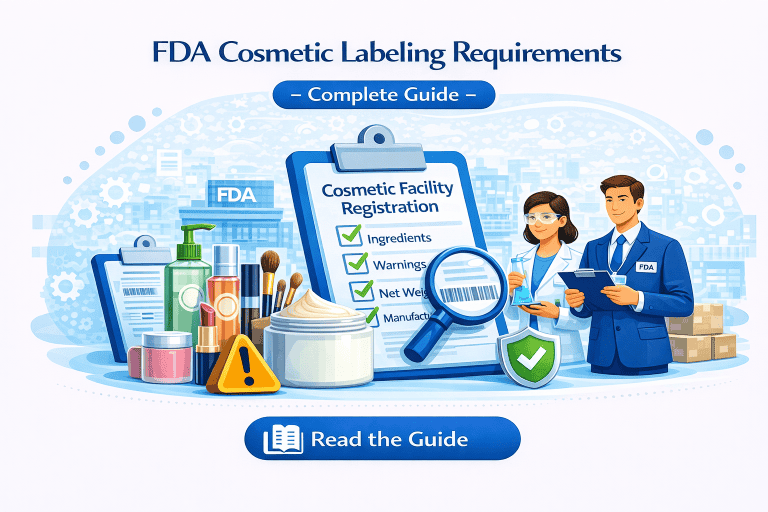
FDA Cosmetic Labeling Requirements
Trusted by 1,000+ companies across 135+ countries, with 15+ years of FDA regulatory experience. Below: what goes on each panel, the ingredient rules brands get wrong, what MoCRA added, and the claims that turn a label into a problem.
Two Panels, Different Jobs
FDA cosmetic labeling splits the required information between two areas of the package. Putting the right element in the right place is half of compliance.
| Principal Display Panel (PDP) | Information Panel |
|---|---|
| The front, most likely seen at retail | Usually right of the PDP, or on the back or side |
| Identity statement — what the product is | Ingredient declaration (INCI, descending order) |
| Net quantity of contents (U.S. + metric) | Name & place of business |
| Warnings, directions & the MoCRA adverse-event contact |
The Required Label Elements
Ingredient Labeling Rules
The ingredient declaration is where compliant labels most often slip. The rules under 21 CFR 701.3:
What MoCRA Added to the Label
MoCRA introduced three label mandates beyond the FD&C Act and FPLA. Two are already in force; one is still on the way.
| MoCRA label addition | Status |
|---|---|
| Adverse-event contact (U.S. address, phone, or electronic) | Required since Dec 29, 2024 |
| “For professional use only” statement, plus full consumer labeling | Required since Dec 29, 2023 |
| Individual fragrance-allergen disclosure | Coming — FDA proposed rule expected in 2026, not yet final |
The adverse-event contact may be a website, but it must be a genuine channel the Responsible Person monitors — it ties the label to your post-market obligations.
Claims That Get a Label in Trouble
Get Your Cosmetic Label Reviewed Before You Print
Send us your label artwork and product details, and we'll check every element — identity, net quantity, INCI ingredients, business name, warnings, claims, and the MoCRA adverse-event contact — and align it with your facility registration and product listing, so you avoid reprints, detentions, and pulled listings. Email info@fdaregistrationassistance.com or call +1 (928) 275-8333.
Frequently Asked Questions — FDA Cosmetic Labeling
What must a compliant cosmetic label include?
At minimum: an identity statement and net quantity on the principal display panel; an ingredient declaration in INCI names and the name and place of business on the information panel; any required warnings; and, under MoCRA, a U.S. contact for adverse event reports — all in English.
What's the difference between the PDP and the information panel?
The principal display panel (PDP) is the front, most likely seen at retail, and carries the product identity and net quantity. The information panel — usually to the right or on the back — carries the ingredient list, the business name and address, and warnings.
What is the identity statement?
A clear statement of what the product is — “shampoo,” “moisturizing cream,” “lipstick” — displayed prominently on the PDP so consumers know the nature of the product (21 CFR 701.11).
How must net quantity be shown?
In both U.S. customary units (ounces or fluid ounces) and metric units (grams or milliliters), placed in the bottom 30% of the PDP (21 CFR 701.13). Showing only one system is a common error.
Do I really need both U.S. and metric units?
Yes. The Fair Packaging and Labeling Act requires the net quantity of contents in both U.S. customary and metric units. Listing only one of the two is a labeling violation.
How do I list ingredients correctly?
Use INCI names in descending order of predominance by weight. Ingredients present at 1% or less, and color additives, may be listed in any order after those present at more than 1% (21 CFR 701.3).
What are INCI names?
International Nomenclature of Cosmetic Ingredients — the standardized ingredient names the FDA recognizes for cosmetic labeling. Using a marketing or common name instead of the INCI name can make a label non-compliant.
How do I list fragrance and color?
Fragrance and flavor may currently be declared collectively as “fragrance” or “flavor,” and color additives listed after the 1% ingredients. A coming MoCRA rule will require individual fragrance-allergen disclosure.
What goes in the name and place of business?
The name and address of the manufacturer, packer, or distributor. If the named party isn't the maker, it must be qualified — for example “Manufactured for…” or “Distributed by…” (21 CFR 701.12).
What warnings might my product need?
Part 740 warnings apply to certain products — aerosols and self-pressurized containers, foaming bath products, feminine deodorant sprays, and products whose safety hasn't been substantiated, which must bear a specific safety warning.
What did MoCRA add to cosmetic labels?
Three things: a U.S. contact for adverse event reports (since Dec 29, 2024); a “professional use only” statement (since Dec 29, 2023); and fragrance-allergen disclosure, coming via a future rule. See our MoCRA overview.
Is the adverse-event contact on the label mandatory now?
Yes. Since December 29, 2024, every cosmetic label must carry a U.S. address, phone number, or electronic contact — a website is acceptable — through which the Responsible Person can receive adverse event reports.
Do professional-use products need full labeling?
Yes. Since December 29, 2023, professional-use cosmetics must state that they are for use by licensed professionals and must carry the same labeling as consumer products, including the full ingredient list.
Do I have to list fragrance allergens yet?
Not yet. MoCRA directs the FDA to require individual fragrance-allergen labeling, but the rule defining which allergens and at what levels is still in development, with a proposed rule expected in 2026. Gathering allergen data now is wise.
Can I put “FDA approved” on my cosmetic?
No. The FDA does not approve cosmetics, so “FDA approved” is false and misleading and can itself trigger enforcement. You may state that your facility is “FDA registered” if it genuinely is.
When does a cosmetic claim become a drug claim?
When it claims to treat or prevent a condition, or to affect the body's structure or function — acne, anti-dandruff, SPF, antiperspirant. That shifts the product to an OTC drug — see OTC drug label compliance.
Are “natural,” “organic,” or “hypoallergenic” regulated terms?
The FDA does not define “natural,” “hypoallergenic,” or “clean” for cosmetics, and “organic” may involve USDA rules. These claims aren't banned, but they must be truthful and not misleading.
Do imported cosmetics need a country-of-origin statement?
Yes. Imported products must bear a country-of-origin marking under U.S. Customs rules, in addition to meeting all FDA cosmetic labeling requirements before entry.
What language must the label be in?
English. If the label also uses another language, all required information must appear in that language too — not only in English — to remain compliant.
What is misbranding?
A cosmetic is misbranded if its labeling is false or misleading, omits required information, or isn't prominent enough to read (FD&C Act §602). Misbranding is a leading cause of import detention.
What about very small packages?
Very small or oddly shaped packages may use off-pack labeling — a tag, tape, or accompanying leaflet — for the ingredient declaration within FDA allowances, while identity and net quantity still appear on the container itself.
Does the label have to match my FDA registration and listing?
Yes. Under MoCRA, your label, facility registration, and product listing should be consistent — the Responsible Person on the label should match your listing records.
Will Amazon or retailers check my label?
Yes. Marketplaces and retailers increasingly run their own label compliance reviews, and a non-compliant label can be rejected before the product ever reaches a consumer.
How do I fix a non-compliant cosmetic label?
Review each element — identity, net quantity, ingredients, business name, warnings, and the MoCRA contact — against the FDA rules and correct the artwork before printing. Reviewing artwork before production avoids reprints and port problems.
Can you review my cosmetic label?
Yes. We review cosmetic labels against the full FDA and MoCRA framework and align them with your registration and listing. Contact our team — email info@fdaregistrationassistance.com or call +1 (928) 275-8333.