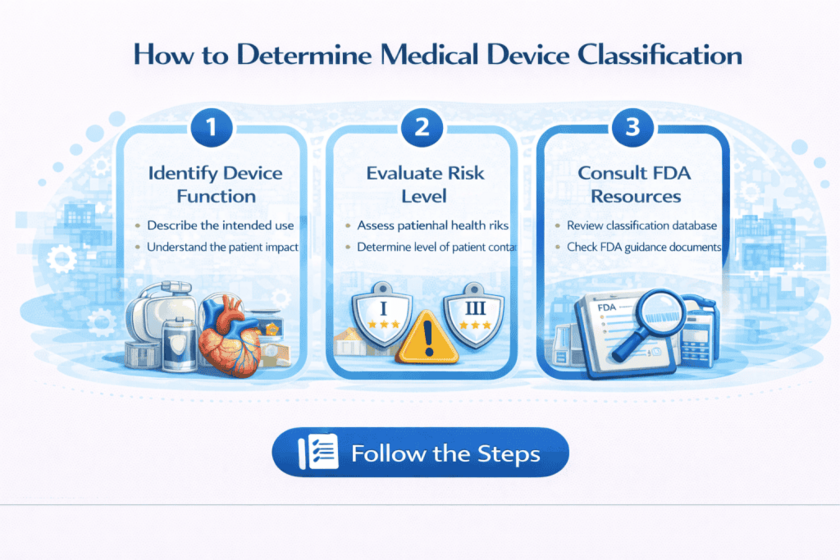
How to Determine Medical Device Classification
Medical device classification is one of the most important FDA decisions a company makes before registration, listing, labeling, importing, or marketing a device in the United States. The correct classification determines the level of FDA control, whether premarket review may be required, what quality system obligations apply, and how the device should be listed with FDA.
What classification affects
FDA classification is based on risk and regulatory controls
Class I
Class I devices are generally lower risk and usually subject to general controls. Many Class I devices are exempt from premarket notification, but companies may still need registration, listing, labeling compliance, and quality system controls.
Class II
Class II devices present moderate risk and normally require general controls plus special controls. Many Class II devices require 510(k) clearance unless a specific exemption applies.
Class III
Class III devices are generally higher risk, life-supporting, life-sustaining, implanted, or of substantial importance in preventing impairment of human health. These devices often require premarket approval.
Classification is not just a label — it controls the entire FDA strategy
A medical device should not be classified only by its appearance, price point, technology, or what competitors appear to be doing online. FDA classification depends on the device’s intended use, indications for use, technological characteristics, risk profile, product code, applicable regulation, and whether legally marketed predicate devices exist.
For foreign manufacturers, private label companies, importers, specification developers, and distributors, a classification mistake can create serious downstream problems. A device that was listed under the wrong product code may appear registered but still be noncompliant. A product marketed as exempt may actually require 510(k) clearance. A labeling claim may push the device into a higher classification or different regulatory pathway.
FDA Registration Assistance helps companies evaluate classification before they register, list, import, or launch medical devices in the U.S. market. For broader support, visit our Medical Device Establishment Registration, Medical Device Listing, and Medical Device Labeling & Product Review pages.
The practical method for determining medical device classification
1. Confirm the product is actually a medical device
The first question is whether the product meets the legal definition of a medical device. A product may be a medical device if it is intended for diagnosis, cure, mitigation, treatment, or prevention of disease, or intended to affect the structure or function of the body, and does not achieve its primary intended purposes through chemical action or metabolism.
2. Define the intended use and indications for use
FDA classification starts with what the device is intended to do. Intended use may be shown through labels, instructions, website claims, brochures, Amazon listings, distributor materials, training materials, and customer-facing descriptions. Small wording differences can change the classification analysis.
3. Search for the correct product code
FDA product codes identify the generic category of the device. The product code helps determine the device class, regulation number, submission type, review panel, and possible exemptions. FDA’s Product Classification Database is a primary tool for this analysis.
4. Review the applicable 21 CFR regulation
Once a likely product code is identified, the related classification regulation should be reviewed carefully. The regulation may describe the device, class, limitations, special controls, and whether premarket notification exemption may apply.
5. Compare technological characteristics
Two devices may have similar intended use but different technology, materials, software functions, energy sources, sterility status, measuring features, or patient-contact characteristics. These differences may affect risk and regulatory pathway.
6. Evaluate whether FDA clearance or approval may be required
After class and product code are identified, the company must determine whether the device is exempt, requires 510(k) clearance, may need a De Novo request, or requires premarket approval. Classification and pathway are connected, but they are not the same thing.
Class I vs Class II vs Class III medical devices
| FDA Class | General Risk Level | Typical Controls | Common Premarket Position | Common Business Risk |
|---|---|---|---|---|
| Class I | Lower risk | General controls such as registration, listing, labeling, records, and applicable quality system requirements. | Many are 510(k)-exempt, but exemption must be verified by product code and regulation. | Assuming exemption means no FDA obligations at all. |
| Class II | Moderate risk | General controls plus special controls such as performance standards, guidance, labeling requirements, or postmarket controls. | Many require 510(k) clearance unless specifically exempt. | Listing a device before confirming whether clearance is required. |
| Class III | Higher risk | General controls plus premarket approval and extensive safety and effectiveness evidence. | Often requires PMA unless another pathway applies. | Underestimating the cost, evidence, and timing required before marketing. |
Classification should be completed before FDA registration and listing
Many companies contact FDA Registration Assistance after they have already registered a facility or listed a device incorrectly. While some errors can be corrected, a wrong classification may create issues with import entries, distributors, Amazon compliance reviews, customer due diligence, FDA inspections, and future submissions.
Official FDA and legal references used in classification review
A complete classification review should be grounded in official sources, not assumptions. FDA’s classification database, FDA’s classification guidance pages, the Federal Food, Drug, and Cosmetic Act, and the device classification regulations in 21 CFR are core references.
FDA classification resources
FDA explains that medical device classification is risk based and that devices are categorized into Class I, Class II, or Class III depending on risk and the controls needed to provide reasonable assurance of safety and effectiveness.
Regulatory text and product codes
The classification regulation and product code database help connect a device type to its FDA class, regulation number, medical specialty panel, and premarket review expectations.
What can happen when classification is wrong
Common mistakes companies make during classification
Using a competitor’s listing as the only evidence
Competitor listings can be helpful starting points, but they are not proof that your device has the same intended use, technology, claims, labeling, or regulatory pathway.
Confusing FDA registration with FDA clearance
Registration and listing do not mean FDA cleared, approved, certified, or endorsed the device. Companies must avoid marketing language that misrepresents FDA status.
Ignoring labeling and website claims
FDA evaluates intended use based on how the product is promoted. A product that appears low risk may become higher risk because of disease, diagnostic, therapeutic, or performance claims.
Assuming Class I means no obligations
Class I devices may still require establishment registration, device listing, compliant labeling, complaint handling, records, and applicable quality system compliance.
When should classification be reviewed?
The best time to review classification is before manufacturing decisions, label design, packaging approval, website copy, distributor onboarding, import planning, or FDA establishment registration. Classification should also be reviewed when a device changes design, material, software, sterility status, claims, indications, target population, or method of operation.
Need help determining your medical device classification?
FDA Registration Assistance is a U.S.-based FDA compliance consulting firm located in Miami, Florida, USA. Our team assists medical device companies with classification review, product code evaluation, establishment registration, device listing, U.S. Agent service, DUNS support, labeling review, and FDA compliance strategy.
We have assisted 1,000+ companies across 135+ countries with 15+ years of combined experience in FDA registration and compliance support. Contact us at info@fdaregistrationassistance.com for help reviewing your device before you register, list, import, or market in the United States.
Frequently asked questions about determining medical device classification
1. What is medical device classification?
Medical device classification is FDA’s system for placing a device into Class I, Class II, or Class III based on risk and the level of regulatory control needed to provide reasonable assurance of safety and effectiveness.
2. Who determines the classification of a medical device?
The company is responsible for determining the correct classification before marketing, but FDA regulations, FDA product codes, classification databases, guidance documents, and prior FDA decisions should be used to support the conclusion.
3. What are the three FDA medical device classes?
The three FDA medical device classes are Class I, Class II, and Class III. Class I generally represents lower-risk devices, Class II generally represents moderate-risk devices, and Class III generally represents higher-risk devices that may require premarket approval.
4. Is classification based only on how risky the device seems?
No. Risk is central, but classification also depends on intended use, indications for use, technology, product code, regulation number, special controls, predicate devices, and whether FDA has classified that device type before.
5. What is an FDA product code?
An FDA product code identifies a generic category of medical device. It helps connect the product to its classification, regulation number, medical specialty panel, premarket submission type, and listing information.
6. Where can I search FDA product codes?
You can search FDA product codes in FDA’s Product Classification Database at https://www.accessdata.fda.gov/scripts/cdrh/cfdocs/cfpcd/classification.cfm.
7. Does FDA registration mean my device is cleared?
No. FDA registration and device listing do not mean FDA has cleared, approved, certified, or endorsed the device. Clearance or approval depends on the applicable premarket pathway.
8. Can a Class I device still require FDA registration?
Yes. Many Class I device establishments must register and list their devices unless a specific exemption applies. Class I status does not automatically remove all FDA obligations.
9. Do all Class II devices require 510(k) clearance?
No. Many Class II devices require 510(k) clearance, but some are exempt. The exemption must be confirmed through the exact product code, regulation, limitations, and device claims.
10. Do all Class III devices require PMA?
Many Class III devices require premarket approval, but the correct pathway must be evaluated based on FDA classification, device history, applicable regulations, and FDA requirements for that device type.
11. What is intended use?
Intended use is the purpose for which the device is offered. FDA may evaluate labels, instructions, advertising, websites, sales materials, and other evidence to determine what the company intends the product to do.
12. What are indications for use?
Indications for use describe the disease, condition, patient population, body part, or clinical situation for which the device is intended. Indications can be narrower than intended use and may affect classification and premarket pathway.
13. Can marketing claims change classification?
Yes. Claims about diagnosis, treatment, prevention, monitoring, disease management, clinical performance, or therapeutic benefit can change how FDA views the device and may affect classification or submission requirements.
14. Can two similar devices have different classifications?
Yes. Similar-looking devices may have different classifications if their intended use, technology, materials, patient contact, sterility, software functions, energy source, or performance claims are different.
15. What is a regulation number?
A regulation number is the citation in 21 CFR that describes a device type and its classification. It is commonly connected to a product code and used to evaluate controls and submission expectations.
16. What are general controls?
General controls are baseline FDA requirements that may include registration, listing, labeling, good manufacturing practice requirements, records, reporting, and prohibitions against misbranding and adulteration.
17. What are special controls?
Special controls are additional regulatory controls that may apply to Class II devices. They can include performance standards, postmarket surveillance, patient registries, special labeling, guidance documents, or other measures.
18. What is a 510(k)?
A 510(k) is a premarket notification submission used to demonstrate that a device is substantially equivalent to a legally marketed predicate device, when a 510(k) is required for that device type.
19. What is De Novo classification?
De Novo classification is a pathway for certain novel devices when no legally marketed predicate exists and the device can be classified into Class I or Class II with appropriate controls.
20. What is PMA?
PMA means premarket approval. It is typically required for high-risk Class III devices and generally requires extensive evidence to support safety and effectiveness before marketing.
21. Should I classify my device before designing the label?
Yes. Classification should be reviewed before finalizing labels, instructions, packaging, websites, Amazon listings, brochures, and distributor materials because claims can affect classification and regulatory pathway.
22. Should foreign medical device companies review classification before appointing a U.S. Agent?
Yes. Foreign establishments should understand classification before registration and listing so the U.S. Agent appointment, device listing, product code, and regulatory obligations are aligned correctly.
23. Can FDA Registration Assistance determine my device classification?
FDA Registration Assistance can help review the device’s intended use, claims, technology, product code options, regulation numbers, listing considerations, and related FDA compliance requirements before you move forward.
24. What information is needed for a classification review?
A useful review normally requires the device description, intended use, indications, labeling, instructions for use, website claims, materials, specifications, software features if applicable, sterility status, photos, and any competitor or predicate information.
25. What should I do if I am not sure which class applies?
Do not guess. Review FDA’s classification database, applicable 21 CFR regulations, intended use, claims, and possible predicates. If uncertainty remains, get regulatory support before registering, listing, importing, or marketing the device.