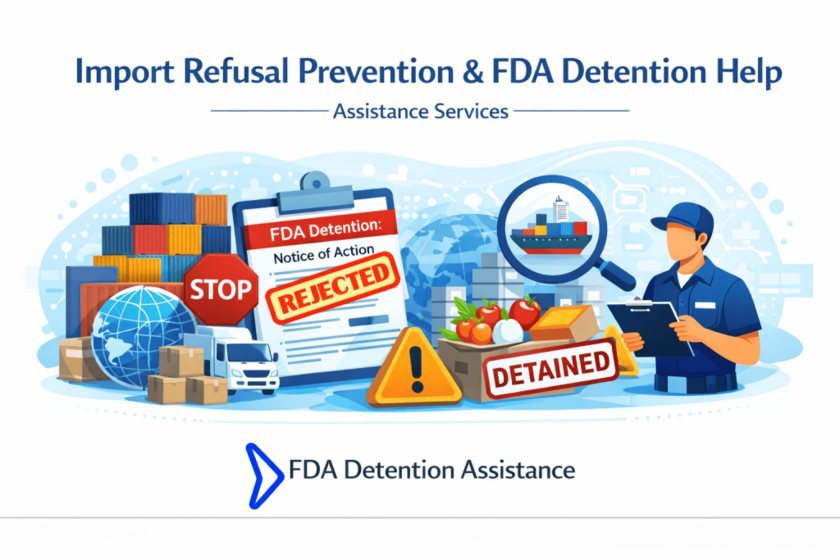
Import Refusal Prevention & FDA Detention Help
This guide explains exactly how FDA import detention works — the Notice of FDA Action process, the three outcomes for a detained shipment, DWPE, the most common Import Alerts, how to respond to a detention, how to get removed from an Import Alert, and what pre-shipment steps prevent detentions.
The Three Possible Outcomes for a Detained FDA Shipment
When FDA detains a shipment, it issues a Notice of FDA Action (Form FDA 2535a) specifying the charge — the specific regulatory violation FDA believes exists — and the response deadline. After that notice, three outcomes are possible:
RequirementsEvidence must directly address the specific charge in the Notice of FDA Action. Generic documentation is insufficient.
TimelineTypically 10 working days from the Notice date to respond. Fast, accurate documentation is the key.
Available forLabeling violations (missing information, incorrect format). NOT available for adulterated products (contamination, pathogens, excessive pesticides).
ProcessReconditioning plan must be submitted to and approved by FDA before any relabeling work begins.
Financial impactStorage, demurrage, and refrigeration fees continue accruing. Re-export or destruction costs added. Prior refusal recorded in FDA database — increases scrutiny on future shipments.
Import Alert riskPatterns of refusals can lead to Import Alert placement — causing automatic DWPE for all future shipments.
What Is Detention Without Physical Examination (DWPE)?
DWPE means FDA automatically detains a shipment without physically inspecting it. Most food import detentions are DWPE — triggered automatically by FDA’s OASIS screening system when it detects: (1) an Import Alert listing for the firm or product; (2) the facility’s FDA registration is expired or not found; (3) Prior Notice was not filed or contains errors; or (4) the product matches a pattern of prior violations. The importer must provide documentation to overcome the presumption of non-compliance — physical inspection of the product is not the trigger or the solution.
Common FDA Import Alerts That Affect Food, Drug, and Device Importers
An Import Alert causes automatic DWPE for every shipment from a listed firm or for a listed product category — indefinitely, until the firm petitions for removal. These are the most commonly triggered Import Alerts:
| Import Alert | Category | Basis for Detention | Common Triggers | Resolution |
|---|---|---|---|---|
| IA 36-07 | Food — LACF | Low-acid canned food without valid FCE registration or SID filing | Foreign LACF processor unaware of FCE/SID requirement; FCE expired; SID not filed for new product | Complete FCE registration + SID filings; submit corrective action documentation to FDA |
| IA 36-08 | Food — Acidified | Acidified food without valid FCE registration or SID filing | Same as IA 36-07 for salsa, hot sauce, pickled products, relishes | Complete FCE registration + SID filings for all affected products |
| IA 57-09 | Food — Labeling | Food products that appear to be misbranded under 21 U.S.C. 343 | Missing required label elements; unauthorized health claims; allergen declaration violations | Corrected labels + evidence labels have been updated; may require affirmative steps to prove compliance |
| IA 99-23 | Food — Pesticides | Food products with pesticide residue violations | Pesticide residues exceeding U.S. tolerances or no established U.S. tolerance; imported tea and produce common | Negative pesticide test results from accredited labs on multiple consecutive lots |
| IA 66-66 | All categories | All FDA-regulated products from a firm — reserved for serious systemic violations | Multiple violation categories; significant inspection findings; systemic compliance failure | Comprehensive corrective action program; formal petition to FDA; typically most difficult removal |
| IA 89-06 | Drugs | Drug establishment registration violations | Foreign drug facility not registered under 21 CFR Part 207 or registration expired | Complete drug establishment registration; annual renewal current |
| IA 32-28 | Medical Devices | Device establishment registration violations | Foreign device facility not registered under 21 CFR Part 807 or registration expired | Complete device establishment registration; annual renewal current |
Responding to a Notice of FDA Action — What Must Happen and When
Step 1 — Read the Charge Immediately
The Notice of FDA Action (Form FDA 2535a) specifies the exact regulatory charge. The charge determines exactly what evidence must be submitted. A detention for an expired facility registration requires different documentation than a detention for a labeling violation. Do not assume. Read the specific regulation cited and respond to that charge specifically.
Step 2 — Act Immediately — Deadline Is 10 Working Days
For food detentions under 21 CFR Part 1.94, the importer typically has 10 working days from the Notice date to submit evidence of compliance or request a hearing. This deadline is strict — missing it results in automatic refusal. Begin assembling documentation the same day the Notice is received. Storage fees accrue daily.
Step 3 — Submit Documentation That Directly Addresses the Charge
Generic compliance documentation does not work. The response must include evidence that directly addresses the specific charge: current FDA facility registration certificate (for registration violations); corrected Prior Notice with accurate data (for Prior Notice violations); corrected label files or reconditioning plan (for labeling violations); laboratory test results (for adulteration); FSVP documentation (for FSVP violations); FCE and SID documentation (for LACF violations).
Step 4 — Coordinate with Your Customs Broker on Storage
While assembling the FDA response, coordinate with your customs broker on storage location and cost. Storage fees at U.S. ports and bonded warehouses accrue daily. For refrigerated or frozen product, cold storage costs accumulate quickly. Understanding the total financial exposure helps make timely decisions about whether to pursue release, reconditioning, or re-export.
Pre-Shipment Checklist — What Prevents FDA Import Detentions
- Facility registration verified and current — the manufacturing facility’s FDA Food Facility Registration is active. Check especially around the Biennial Renewal window (October–December of even years) when lapsed registrations are most common. One verification tool: FDA FURLS public search.
- U.S. Agent designation active — foreign facility has a designated U.S. Agent with a physical U.S. address. FDA must be able to reach the U.S. Agent. An inactive or unresponsive U.S. Agent can cause registration problems that trigger detention.
- No Import Alert for the facility, product, shipper, or country — search FDA’s Import Alert database before shipment. Import Alerts are public. If the facility appears on an Import Alert, every shipment will be detained — resolve the alert before shipping.
- FCE and SID on file for LACF and acidified foods — if the product is a low-acid canned food or acidified food, FCE registration and SID filing must be complete and current before the shipment. No FCE/SID = automatic Import Alert 36-07 or 36-08 detention.
- Prior Notice filed accurately — Prior Notice must be filed with the correct FDA facility registration number, correct FDA product code, and accurate importer information before the shipment arrives. Errors trigger OASIS flags.
- Label compliance confirmed — the product label complies with 21 CFR Part 101: 2020 Nutrition Facts format, correct RACC serving size, allergen declarations including sesame (FASTER Act, January 2023), English language. A non-compliant label is a misbranding charge under 21 U.S.C. § 343.
- FSVP documentation current — FSVP program is written, hazard analysis is complete for each supplier and each food, supplier verification activities are current, and 2-year records are maintained. FDA can request FSVP records within 24 hours.
- No restricted or prohibited ingredients — for dietary supplements and herbal products, verify no ingredients on FDA’s restricted or prohibited list (ephedra, aristolochic acid, comfrey for internal use, etc.). Adulteration charges are the hardest detentions to resolve.
Shipment Currently Detained? Contact Us Immediately.
FDA detention deadlines are strict. Failure to respond within the specified timeframe results in automatic refusal. If your shipment has received a Notice of FDA Action, contact FDA Registration Assistance now — provide the Notice, the entry number, and the product information. Response begins immediately.
Call +1 (928) 275-8333 or email info@fdaregistrationassistance.com
Pre-Shipment Reviews and Import Alert Removal
FDA Registration Assistance provides pre-shipment compliance reviews covering facility registration verification, Import Alert screening, label review, FSVP status, and FCE/SID verification — before your shipment leaves the origin country. Also: Import Alert removal assistance, Notice of FDA Action response, and U.S. Agent designation for foreign facilities. 1,000+ clients. 135+ countries. 15+ years of FDA regulatory experience.
Contact us at info@fdaregistrationassistance.com or call +1 (928) 275-8333.
Frequently Asked Questions — Import Refusal Prevention & FDA Detention Help
1. What is an FDA import detention?
An FDA import detention occurs when FDA holds a shipment at a U.S. port because it “appears to violate” the Federal Food, Drug, and Cosmetic Act. FDA issues a formal Notice of FDA Action (Form FDA 2535a) specifying the charge and the response deadline. The shipment cannot enter U.S. commerce until the importer provides satisfactory evidence of compliance or the deadline passes — triggering automatic refusal.
2. What does Detention Without Physical Examination (DWPE) mean?
DWPE means FDA automatically detains a shipment without physically inspecting it — triggered by Import Alert listing, expired facility registration, Prior Notice errors, or OASIS screening flags. To secure release from DWPE, the importer must provide documentation proving compliance. Physical inspection of the product is not the trigger or the solution.
3. What is a Notice of FDA Action and what does it require?
The Notice of FDA Action (Form FDA 2535a) specifies the product, entry number, charge (specific regulatory violation), action taken, and response deadline. For food detentions under 21 CFR Part 1.94, the importer typically has 10 working days to respond with evidence addressing the specific charge. Missing the deadline = automatic refusal.
4. What are the three possible outcomes for a detained FDA shipment?
(1) Release — importer provides satisfactory documentation; shipment enters U.S. commerce. (2) Reconditioning — for labeling violations only; shipment conditionally released for relabeling under FDA supervision. (3) Refusal of admission — product must be re-exported or destroyed. Prior refusal recorded in FDA database; increases future detention risk.
5. What is an FDA Import Alert?
An FDA Import Alert is a standing directive causing automatic DWPE for every shipment from a listed firm or for a listed product category. Import Alerts are published on FDA’s website. Common food Import Alerts: IA 36-07 (LACF without FCE/SID), IA 36-08 (acidified foods without FCE/SID), IA 57-09 (labeling violations), IA 99-23 (pesticide residues). Import Alert placement means every future shipment is automatically detained until formal removal is obtained.
6. What are the most common reasons FDA detains food shipments?
Most common: facility registration expired or missing; Prior Notice not filed or contains errors (wrong facility registration number or product code); Import Alert for the facility or product; missing FCE and SID for LACF or acidified foods; labeling violations (misbranding under 21 U.S.C. § 343); adulteration (pesticide residues, heavy metals, pathogens); and no valid U.S. Agent for foreign facility.
7. What is FDA reconditioning for detained shipments?
Reconditioning is relabeling or reworking a detained shipment into compliance under FDA supervision. Available for labeling violations only — NOT for adulterated products (contamination, pathogens, excessive pesticide residues). A reconditioning plan must be submitted to and approved by FDA before any work begins. After reconditioning, FDA re-examines the shipment before release.
8. How do I respond to a Notice of FDA Action for a food shipment?
Read the specific charge — the cited regulation determines exactly what evidence must be submitted. Act immediately — 10 working days for food under 21 CFR Part 1.94. Submit documentation that directly addresses the charge — current facility registration certificate, corrected Prior Notice, corrected label files, laboratory tests, or FSVP records as applicable. Coordinate with your customs broker on storage. FDA Registration Assistance provides emergency detention response support.
9. What happens if FDA refuses a food shipment?
The importer must re-export the product to its country of origin (typically within 90 days) or have it destroyed under FDA supervision. Storage and demurrage continue accruing. The refusal is recorded in FDA’s import database — increasing future detention risk and potentially leading to Import Alert placement for the facility.
10. How do I get a firm removed from an FDA Import Alert?
Import Alert removal requires demonstrating that the underlying compliance problem has been corrected. For IA 36-07/36-08: completed FCE registration and SID filings. For IA 99-23 (pesticides): negative lab results from accredited labs on multiple consecutive lots. For IA 57-09 (labeling): corrected labels and documentation. For all: formal removal petition submitted to FDA. Import Alert removal is a strategic process — FDA Registration Assistance assists with removal documentation.
11. What is OASIS and how does it affect FDA import screening?
OASIS (Operational and Administrative System for Import Support) is FDA’s system that automatically screens all food import entries. When a Prior Notice is filed, OASIS checks: the FDA facility registration database; the Import Alert list; the FDA product code database; and other compliance data. Most food import detentions are triggered automatically by OASIS before FDA physically reviews the shipment.
12. What is the most common cause of LACF and acidified food import detentions?
Missing or non-compliant FCE registration or SID filings. Import Alert 36-07 (LACF) and Import Alert 36-08 (acidified foods) are among the most frequently triggered food import alerts — because many foreign LACF and acidified food processors are unaware of the FCE/SID requirement separate from standard FDA Food Facility Registration. Resolving these detentions requires completing FCE registration and SID process filings.
13. Can a prior FDA refusal increase the risk of future detentions?
Yes. Prior refusals are recorded in FDA’s import database and can increase scrutiny on future shipments from the same firm. Patterns of violations lead to Import Alert placement — which causes automatic DWPE for all future shipments. Proactive compliance is significantly less expensive than managing the consequences of refusals.
14. What are the financial consequences of an FDA import detention?
Port storage fees, demurrage charges from ocean carriers, refrigerated storage for temperature-sensitive food, loss of sale or contract penalties, cost of reconditioning if permitted, cost of re-export if refused, cost of destruction, and regulatory consulting costs. For perishable food, the shipment may be economically lost within days of a detention that cannot be quickly resolved.
15. Does an FDA detention affect all shipments from the same manufacturer?
An individual detention does not automatically affect other shipments. However, if the underlying compliance issue is systemic, subsequent shipments face the same risk. If the detention leads to Import Alert placement, every future shipment from that manufacturer is automatically detained until removal is obtained.
16. What documentation does FDA typically request during a detention?
Depends on the charge: registration violations — current FDA facility registration certificate; Prior Notice violations — corrected Prior Notice; FSVP violations — FSVP program documentation; labeling violations — corrected label files; LACF/acidified food violations — FCE and SID documentation; adulteration — laboratory test results from accredited laboratories. All documentation must directly address the specific charge in the Notice of FDA Action.
17. How quickly must an importer respond to an FDA detention notice?
For food detentions under 21 CFR Part 1.94, typically 10 working days from the Notice of FDA Action date. The response must include substantive documentation — not just acknowledgment. Begin assembling evidence immediately upon receiving the notice. FDA Registration Assistance provides emergency response for detained shipments.
18. What is the difference between an Import Alert and an individual shipment detention?
An individual detention is a one-time hold on a specific shipment. An Import Alert is a standing directive causing automatic DWPE for every future shipment from the listed firm or for the listed product category — indefinitely, until formal Import Alert removal is obtained. An unresolved individual detention may contribute to eventual Import Alert placement.
19. Can FDA detain medical device or drug shipments for the same reasons as food?
Yes. For drugs: Import Alert 89-06 applies to drug establishments not registered under 21 CFR Part 207. For medical devices: Import Alert 32-28 applies to device firms with registration violations under 21 CFR Part 807. The “appears to violate” standard and the detention response process apply across all FDA-regulated product categories.
20. What pre-shipment steps prevent FDA import detentions?
Verify manufacturing facility FDA registration is active; confirm U.S. Agent is designated and active; check no Import Alert for the facility, product, or shipper; confirm FCE and SID for LACF and acidified foods; verify Prior Notice has correct facility registration number and FDA product code; review product label against 21 CFR Part 101; confirm FSVP documentation is current; and verify no restricted ingredients.
21. What is FDA’s authority to detain imported food?
Established in the Federal Food, Drug, and Cosmetic Act at 21 U.S.C. § 381 (importation refusal authority) and implemented under 21 CFR Part 1.94 (administrative detention of food). Under FSMA, FDA’s import detention authority was significantly strengthened — including DWPE authority based on Import Alerts and authority to require documentation within specified timeframes.
22. What specific FDA Import Alerts most commonly affect food importers?
IA 36-07 (LACF without FCE/SID), IA 36-08 (acidified foods without FCE/SID), IA 57-09 (food labeling violations), IA 99-23 (pesticide residue violations), and IA 66-66 (all FDA-regulated products from a firm — serious systemic violations). Each has specific documentation requirements for removal. FDA Registration Assistance evaluates the applicable Import Alert and develops the removal strategy.
23. Can a detained shipment be relabeled and released?
Yes — if the detention basis is a labeling violation. A reconditioning plan must be submitted to and approved by FDA before any relabeling work begins. FDA re-examines the shipment after relabeling before release. Reconditioning is not available for adulterated products. FDA makes case-by-case reconditioning determinations.
24. How does FDA Registration Assistance help with import refusal prevention and detention response?
Pre-shipment compliance reviews (registration verification, Import Alert screening, label review, FSVP status, FCE/SID verification); emergency detention response for Notices of FDA Action; Import Alert removal assistance; FSVP emergency onboarding; and U.S. Agent designation for foreign facilities. 1,000+ clients. 135+ countries. 15+ years of FDA regulatory experience.
25. How do I get started with import refusal prevention or detention response?
If your shipment is detained: contact FDA Registration Assistance immediately at info@fdaregistrationassistance.com or call +1 (928) 275-8333. Provide the Notice of FDA Action, entry number, product type, and manufacturing facility information. For pre-shipment prevention: provide product type, facility information, FDA registration status, and destination.