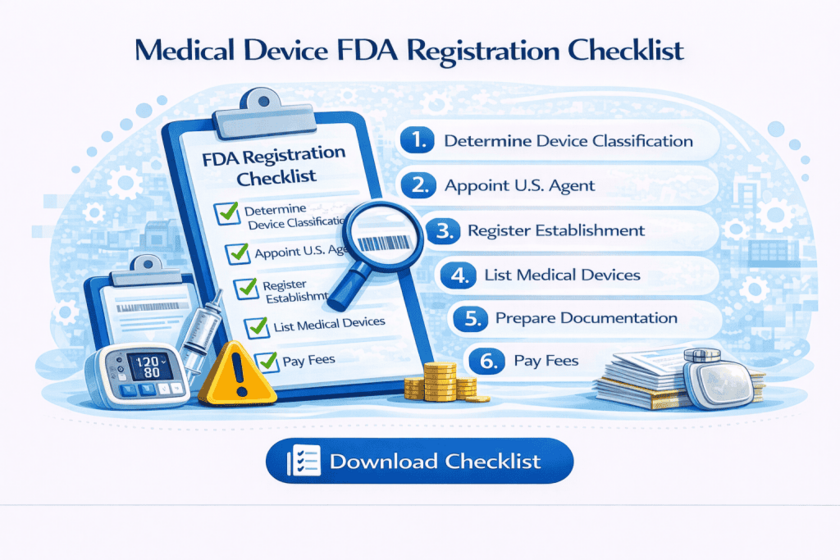
Medical Device FDA Registration Checklist
Before a medical device is manufactured, imported, distributed, or sold in the United States, the company responsible for the device must understand FDA establishment registration, device listing, product classification, labeling, U.S. Agent obligations, import requirements, and post-registration compliance duties.
Quick Facts
Medical Device FDA Registration at a Glance
Introduction
Why Medical Device FDA Registration Matters
Medical device FDA registration is one of the first compliance steps for many companies entering the U.S. market, but it is not the only requirement. A device company must understand whether the product is legally a medical device, how it is classified, whether the establishment must register, whether the device must be listed, whether premarket review is required, and whether the labeling and intended use are aligned with FDA requirements.
The business impact can be significant. A company may invest in manufacturing, packaging, e-commerce listings, distributor contracts, freight, customs entry filings, or Amazon launch plans before discovering that the device record is incomplete, the establishment is not registered, the foreign manufacturer has no valid U.S. Agent, or the device claims require a different regulatory pathway.
FDA registration problems can lead to import detentions, refusal risk, marketplace removals, delayed launches, relabeling costs, buyer distrust, and regulatory questions that slow commercial growth. A complete checklist helps companies identify gaps before shipments move, before products are listed online, and before a customer or broker asks for proof of FDA compliance.
This checklist is written for medical device manufacturers, contract manufacturers, specification developers, foreign exporters, initial importers, distributors, private label brands, Amazon sellers, and companies preparing to appoint a U.S. Agent for FDA medical device registration.
Core Checklist
Step 1: Confirm Whether the Product Is a Medical Device
Intended Use Drives Classification
FDA evaluates medical devices based heavily on intended use. A product may become a medical device because it is intended to diagnose, cure, mitigate, treat, or prevent disease, or because it is intended to affect the structure or function of the body without being dependent on chemical action.
Marketing claims, website language, package text, instructions, catalog descriptions, Amazon listings, distributor statements, and user manuals can all influence how FDA views the product.
Common Device Examples
Examples may include diagnostic equipment, monitoring devices, surgical instruments, wound care products, mobility devices, dental devices, software with medical functionality, masks with medical claims, imaging equipment, sterilized accessories, and many products used by healthcare professionals or patients.
A product should not be registered as a device simply because the company wants an FDA registration number. The correct first question is whether the product actually meets the legal definition of a device.
Step 2: Identify the Device Classification
Medical devices are generally classified into Class I, Class II, or Class III depending on risk and regulatory controls. Classification affects registration strategy, device listing, labeling obligations, quality system requirements, and whether the device may require premarket notification, De Novo classification, or premarket approval.
Class I Devices
Class I devices are generally lower risk and often subject to general controls. Some Class I devices may be exempt from 510(k) requirements, but exemption does not automatically remove all FDA obligations.
Class II Devices
Class II devices often require general controls and special controls. Many Class II devices require 510(k) clearance before marketing unless a specific exemption applies.
Class III Devices
Class III devices are typically higher risk and may require premarket approval. These devices require deeper regulatory planning before commercial launch.
Step 3: Determine Which Establishments Must Register
FDA medical device establishment registration is tied to the activities performed by the establishment. Companies involved in manufacturing, preparing, propagating, compounding, assembling, processing, specification development, relabeling, repackaging, remanufacturing, sterilization, importing, or other regulated activities may have FDA registration obligations depending on their role.
Step 4: Prepare Device Listing Information
Device listing connects a registered establishment to the devices it manufactures, imports, processes, or distributes. The device listing should accurately reflect the product, product code, regulation number, proprietary names, classification, activities, and related establishment roles.
Information Commonly Needed
Why Accuracy Matters
Incorrect listing information can create problems at import, during buyer due diligence, during marketplace review, or when FDA compares device records with product labeling and shipment data. A listing should be treated as a regulatory record, not a marketing certificate.
Compliant vs Non-Compliant Medical Device Registration
| Compliance Area | Compliant Approach | Non-Compliant or Risky Approach |
|---|---|---|
| Device Classification | Classification is reviewed using FDA product codes, regulation numbers, intended use, and applicable controls. | The company guesses the class based on similar-looking products or competitor listings. |
| Establishment Registration | The correct establishment roles are identified before the registration is submitted. | One company registers while other regulated facilities in the supply chain are ignored. |
| Device Listing | Product code, device name, activity, premarket status, and manufacturer information are consistent. | The device is listed with incomplete, mismatched, or generic information. |
| Foreign Manufacturer | A valid U.S. Agent is appointed and importer information is maintained. | The foreign company ships to the U.S. with no proper U.S. Agent or outdated registration records. |
| Labeling and Claims | Labels, manuals, websites, and online listings match the cleared, exempt, or authorized intended use. | Marketing claims expand the intended use beyond the device’s legal pathway. |
| Imports | FDA registration, device listing, product code, manufacturer records, and entry information align before shipment. | The shipment arrives before compliance records are checked, causing broker questions and FDA delays. |
Key Compliance Section
Legal Authority and Official FDA Sources
Medical device registration and listing requirements are grounded in the Federal Food, Drug, and Cosmetic Act and FDA regulations. The FD&C Act gives FDA authority over medical devices, including provisions related to registration, listing, adulteration, misbranding, premarket review, imports, inspections, and enforcement.
FDA’s medical device registration and listing regulations are primarily found in 21 CFR Part 807. Device classification regulations appear throughout 21 CFR Subchapter H. Quality system requirements are addressed in 21 CFR Part 820. FDA also provides official guidance on Device Registration and Listing and Importing Medical Devices.
A device may be considered misbranded if required information is false, misleading, incomplete, or not presented as required. A device may be considered adulterated when it fails to meet applicable manufacturing, quality, approval, clearance, or other statutory requirements. FDA’s enforcement powers may affect shipments, registrations, inspections, labels, marketplace access, and commercial distribution.
Real-World Risks of Incomplete Device Registration
Common Reasons Medical Device Companies Fail Registration Reviews
Many companies fail because they treat FDA registration as a simple form instead of a regulatory analysis. Registration should not be started until the company understands the product’s intended use, classification, establishment roles, importer structure, labeling claims, and premarket status.
Documentation Problems
Regulatory Strategy Problems
When Should a Company Act?
A medical device company should begin the FDA registration review before manufacturing labels, booking freight, launching an Amazon listing, appointing a distributor, signing a hospital supply agreement, or offering the product for import into the United States. Early review allows time to correct classification issues, registration gaps, device listing errors, labeling problems, and U.S. Agent details.
Medical Device FDA Registration Support
FDA Registration Assistance is a U.S.-based FDA compliance consulting firm located in Miami, Florida. We help medical device companies understand FDA establishment registration, device listing, U.S. Agent requirements, importer coordination, registration renewals, and compliance documentation.
Our team has assisted more than 1,000 companies in over 135 countries with FDA registration and regulatory compliance matters. With 15+ years of combined experience, we support manufacturers, foreign exporters, importers, distributors, and private label device companies preparing to enter or remain active in the U.S. market.
Contact FDA Registration Assistance at info@fdaregistrationassistance.com or visit https://www.fdaregistrationassistance.com/.
Frequently Asked Questions
Medical Device FDA Registration Checklist FAQs
These FAQs answer common medical device FDA registration questions for manufacturers, importers, foreign establishments, Amazon sellers, distributors, and companies preparing to sell in the United States.
1. What is medical device FDA registration?
Medical device FDA registration is the process by which certain device establishments register with FDA and identify the devices associated with their activities. It helps FDA know where devices are manufactured, processed, imported, or otherwise handled. Registration is an establishment requirement, not a product approval. A registered company still must comply with classification, listing, labeling, quality system, premarket, import, and post-market requirements that apply to the specific device.
2. Does FDA registration mean my device is approved?
No. FDA registration does not mean the device is approved, cleared, certified, or endorsed by FDA. This is one of the most common misunderstandings in the medical device industry. A company may have an active registration number while still needing 510(k) clearance, De Novo authorization, PMA approval, compliant labeling, quality system controls, or other requirements. Registration should never be advertised as FDA approval.
3. Who needs to register a medical device establishment with FDA?
The answer depends on the company’s role. Manufacturers, specification developers, contract manufacturers, sterilizers, relabelers, repackagers, remanufacturers, initial importers, and certain foreign establishments may have registration obligations. The correct analysis starts with identifying each physical establishment and the regulated activity performed there. One company’s registration does not automatically satisfy every establishment in the supply chain.
4. Do foreign medical device manufacturers need a U.S. Agent?
Foreign medical device establishments that register with FDA generally need to identify a U.S. Agent. The U.S. Agent serves as a contact point between FDA and the foreign establishment. The U.S. Agent should be located in the United States, reachable, and able to help facilitate communication. FDA Registration Assistance provides medical device U.S. Agent services for foreign companies entering or maintaining access to the U.S. market.
5. What is device listing?
Device listing is the process of identifying the medical devices associated with a registered establishment. A listing may include device name, product code, regulation number, classification, premarket submission information when applicable, and establishment activity. Listing information should match the actual device and the company’s role. Incorrect listing can create import, buyer, distributor, and FDA compliance problems.
6. How do I know my medical device classification?
Device classification is determined by intended use, technology, risk, applicable classification regulations, product codes, and FDA precedent. Companies should review FDA classification databases, 21 CFR device regulations, and relevant guidance. A visual similarity to another device is not enough. Claims, indications, software functionality, materials, sterilization, patient contact, and clinical use can all affect classification.
7. What information is usually needed for FDA device registration?
Common information includes the legal company name, facility address, owner/operator details, official correspondent, U.S. Agent information for foreign establishments, establishment activities, device names, product codes, regulation numbers, device class, importer information, and premarket submission details when applicable. The exact information depends on the company’s role and the device type.
8. Do initial importers need FDA registration?
Many initial importers of medical devices must register with FDA. An initial importer is generally the establishment that furthers the marketing of a device from a foreign manufacturer to the person who makes final delivery or sale to the ultimate consumer or user. Importer obligations should be reviewed carefully because the initial importer role is different from customs broker, distributor, consignee, and importer of record roles.
9. Can I import a medical device before registration is complete?
Importing before registration, listing, classification, labeling, and premarket status are reviewed can create serious risk. FDA may verify medical device requirements at the time of import. If records are incomplete or inconsistent, the shipment may be delayed, detained, or refused. Companies should complete the compliance review before goods are shipped to the United States.
10. What happens if the wrong product code is used?
Using the wrong product code can cause problems with device listing, customs entry, FDA import screening, buyer review, and regulatory strategy. The product code should reflect the actual device classification and intended use. A wrong code can make the device appear inconsistent with the label, claims, or required premarket pathway. Product code selection should be reviewed before registration and listing are submitted.
11. Are Class I medical devices exempt from all FDA requirements?
No. Some Class I devices may be exempt from certain premarket notification requirements, but that does not mean they are exempt from all FDA requirements. Registration, listing, labeling, general controls, quality system provisions, complaint handling, reporting, and import requirements may still apply depending on the device and establishment activity. Exemption must be confirmed specifically.
12. Do Class II devices require 510(k) clearance?
Many Class II devices require 510(k) clearance before marketing, but some are exempt from 510(k) requirements if the regulation and product code allow an exemption. Companies should not assume that a Class II device is automatically exempt. The intended use, technological characteristics, claims, and classification regulation must be reviewed before commercial distribution.
13. What is the difference between FDA registration and 510(k) clearance?
FDA registration identifies establishments and listed devices in FDA systems. A 510(k) is a premarket submission demonstrating that a device is substantially equivalent to a legally marketed predicate device. Registration is not a substitute for 510(k) clearance when clearance is required. A company may need both registration and a valid premarket pathway before marketing the device.
14. Can FDA Registration Assistance act as our medical device U.S. Agent?
Yes. FDA Registration Assistance provides U.S. Agent services for foreign medical device establishments. We can help coordinate the U.S. Agent designation, registration support, renewal reminders, FDA communication routing, and related compliance documentation. Foreign companies benefit from having a responsive U.S.-based contact that understands FDA device registration procedures.
15. How often must medical device registration be renewed?
Medical device establishment registration generally must be renewed annually during FDA’s registration renewal period. Companies should not wait until the last moment because renewals may require updated establishment information, user fee confirmation when applicable, U.S. Agent details, listing review, and importer information. Missing the renewal window can create business and import disruption.
16. What are the risks of expired medical device registration?
An expired registration can create problems with FDA import screening, distributor qualification, marketplace verification, customer onboarding, and regulatory due diligence. If a shipment is reviewed while registration is inactive or outdated, the company may face delays or questions. Maintaining active registration is a basic requirement for companies that continue to market or import devices into the United States.
17. Do Amazon sellers need medical device FDA registration?
Amazon sellers may need evidence that the responsible manufacturer, importer, or device company has met applicable FDA requirements. Whether the seller itself must register depends on its role. Private label sellers, importers, specification developers, or companies making device claims may have additional responsibilities. Amazon may also request documents that show the product is lawfully marketed.
18. Can I use another company’s FDA registration number?
A company should not use another company’s registration number as if it proves its own compliance. Registration is tied to establishments and activities. Private label, contract manufacturing, importer, distributor, and specification developer relationships must be analyzed carefully. Misrepresenting FDA registration can create buyer disputes, marketplace removals, and regulatory problems.
19. What medical device labeling issues should be checked?
Medical device labeling should be reviewed for intended use, directions, warnings, manufacturer or distributor information, UDI requirements when applicable, claims, symbols, sterility statements, contraindications, instructions for use, and consistency with the device’s classification and premarket status. Labeling problems can cause misbranding risk and may affect import admissibility or marketplace approval.
20. What is misbranding for medical devices?
Misbranding can occur when device labeling is false or misleading, lacks required information, presents unsupported claims, omits necessary warnings, or otherwise fails to meet applicable requirements. Misbranding is a serious issue because it can affect imports, distribution, enforcement, and commercial relationships. Companies should review labels, websites, brochures, and online listings before launch.
21. What is adulteration for medical devices?
Adulteration can involve failures related to quality system requirements, manufacturing controls, approvals, performance standards, or other statutory requirements. A device can be considered adulterated even if the product appears physically intact. Quality system compliance, manufacturing documentation, complaint handling, corrective actions, and proper premarket status are important parts of device compliance.
22. What should foreign manufacturers prepare before shipping devices to the U.S.?
Foreign manufacturers should confirm device classification, establishment registration, device listing, U.S. Agent designation, importer information, premarket status, labeling, invoice descriptions, product codes, and shipment documentation before export. Waiting until the goods arrive at the U.S. port can make corrections more difficult and increase the risk of detention or refusal.
23. Can a distributor register a device for the manufacturer?
A distributor’s role must be reviewed carefully. A distributor may have certain responsibilities, but the manufacturer, specification developer, initial importer, relabeler, or other establishment may still have its own registration or listing obligations. A distributor should not register in a way that misrepresents who manufactures, specifies, imports, or controls the device.
24. How long does medical device FDA registration take?
The timeline depends on whether the company has complete information, whether the device classification is clear, whether a U.S. Agent must be appointed, whether user fee matters are complete, and whether the device listing information is ready. The registration process can move efficiently when the company has the correct facility details, product information, regulatory pathway, and contact information prepared.
25. Why should we use FDA Registration Assistance for medical device registration?
FDA Registration Assistance helps companies avoid common registration mistakes by reviewing the device role, establishment information, U.S. Agent needs, device listing details, classification concerns, import considerations, and renewal obligations. Our U.S.-based team in Miami, Florida supports companies worldwide with practical, professional FDA compliance assistance so they can move forward with greater confidence and fewer preventable delays.