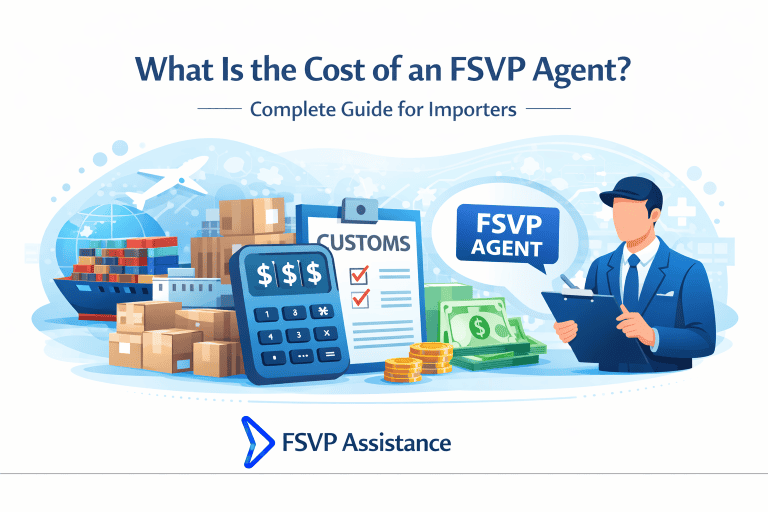
What Is the Cost of an Foreign Supplier Verification Program (FSVP) Agent?
The cost of an Foreign Supplier Verification Program (FSVP) Agent depends on the importer’s role, number of suppliers, number of SKUs, shipment frequency, product risk, documentation quality, and the amount of verification work required. FSVP is not a simple certificate or one-time form. It is a food safety compliance program that must be built, documented, maintained, and ready for FDA review.
FSVP Agent Pricing is Based on Compliance Scope, Not Just One Shipment
FSVP Is a Program
FSVP is not simply a letter, certificate, or broker document. It requires supplier evaluation, hazard analysis review, verification activity decisions, recordkeeping, corrective action readiness, and importer-specific compliance documentation.
Cost Varies by Risk
A low-risk shelf-stable packaged food from one established supplier may require less work than multiple high-risk foods, refrigerated products, seafood, acidified foods, dietary supplements, or suppliers with incomplete documentation.
Importers Need Records
An FSVP Agent or consultant should help the importer maintain records that can support FDA review. The cost should reflect the documentation and verification work needed, not only the title of “FSVP Agent.”
Why FSVP Agent Cost Cannot be Quoted the Same for Every Importer
Importers often ask for a flat Foreign Supplier Verification Program (FSVP) Agent price, but the correct cost depends on the work required to bring the importer’s foreign supplier program into compliance. A single importer may have one supplier, one product, and clean records. Another importer may have several suppliers, many SKUs, recurring shipments, missing hazard analysis documents, incomplete supplier certifications, unclear labels, and urgent shipments already moving toward a U.S. port.
The Foreign Supplier Verification Program requires covered importers to verify that foreign suppliers are producing food in a way that provides the same level of public health protection as applicable U.S. food safety standards. This means the importer needs more than a name to put on entry documents. The importer needs a documented FSVP file that can be reviewed during an FDA inspection.
FDA Registration Assistance helps importers evaluate FSVP responsibilities, appoint FSVP support where appropriate, request supplier documents, review hazard analysis materials, prepare verification records, support entry documentation, and help clients understand what FDA may request during an FSVP inspection.
Main Factors that Determine FSVP Agent cost
Number of Foreign Suppliers
Each Foreign supplier may require separate review. Supplier approval records, food safety plans, certifications, COAs, facility registration, corrective action history, and hazard controls may need to be reviewed before the importer can document a reasonable FSVP position.
Number of Products or SKUs
More SKUs usually means more product specifications, labels, ingredients, hazard considerations, testing documents, and verification records. Even when products come from one supplier, each product may create different compliance questions.
Shipment Volume
A company importing occasionally may need a different support structure than a company importing weekly or monthly. Higher shipment volume can require stronger recordkeeping, entry document coordination, and ongoing compliance maintenance.
Product Risk Profile
Some foods require more careful evaluation because of microbiological, allergen, chemical, temperature control, acidification, seafood, supplement, or ready-to-eat risks. The more complex the food safety profile, the more work the FSVP file may require.
Supplier Documentation Quality
If a supplier has strong food safety documentation, certificates, hazard analysis, COAs, and traceability records, the review may be more straightforward. If records are missing or inconsistent, the importer may need more support before shipment.
Urgency and FDA Status
An importer preparing before shipment usually has more options than an importer facing an urgent broker request, Amazon AGL issue, port delay, FDA hold, or missing FSVP information after goods are already moving.
How FSVP Agent Cost Changes by Importer Situation
| Importer Situation | Typical FSVP Scope | Cost Impact | Why Pricing Must Be Reviewed |
|---|---|---|---|
| One Supplier, One Product | Supplier review, product review, basic Foreign Supplier Verification Program (FSVP) file, entry support, and records setup. | Usually simpler than multi-supplier programs. | The quote still depends on product risk, documentation quality, and shipment timing. |
| One Supplier, Multiple SKUs | Supplier review plus multiple product specifications, labels, ingredients, and hazard considerations. | Higher than a single-SKU review. | Each SKU may require separate review, even when the supplier is the same. |
| Multiple Foreign Suppliers | Separate supplier evaluations, verification records, supplier files, and ongoing monitoring. | Higher due to supplier-by-supplier review. | FSVP is built around foreign supplier verification, so supplier count matters. |
| Recurring Shipments | Ongoing records, entry document review, supplier monitoring, and shipment tracking support. | Usually requires ongoing service. | Recurring activity creates continuing compliance responsibility, not a one-time filing. |
| Urgent Shipment Issue | Rapid document review, entry support, FSVP appointment documentation, and immediate risk assessment. | May require urgent-service pricing. | Short timelines often require more intensive work and faster document coordination. |
| High-Risk or Complex Food | Deeper hazard analysis review, supplier controls, testing records, certificates, and verification planning. | Higher due to technical complexity. | Food safety risk and FDA expectations can significantly affect the required work. |
What should be included in an FSVP Agent or FSVP Support Service?
An Foreign Supplier Verification Program (FSVP) Agent service should be more than a document that lists a U.S. name. The support should help the importer understand its obligations, organize supplier records, prepare documentation, and maintain a defensible FSVP file if FDA asks for it.
Official FDA FSVP Resources Importers Should Understand
Importers should understand that FSVP is an FDA regulation, not simply a broker preference. FDA can inspect FSVP records and may request documentation showing how the importer evaluates and verifies foreign suppliers.
FDA FSVP Overview
FDA provides official information explaining the Foreign Supplier Verification Program for importers of food for humans and animals.
Federal Regulation
FSVP requirements are found in 21 CFR Part 1, Subpart L. Importers should understand the recordkeeping, supplier evaluation, and verification activity requirements that may apply.
What Happens if an Importer Chooses the Cheapest FSVP Option?
Choosing the cheapest FSVP Agent without understanding the scope can create serious problems. A low-cost appointment letter may help a broker move a shipment, but it may not create the supplier verification records needed during an FDA inspection. The importer remains responsible for compliance.
Common Mistakes Importers Make When Comparing FSVP Agent Cost
Thinking FSVP is Only a Letter
A letter may identify an FSVP contact or support provider, but FSVP compliance requires records. FDA may ask for the importer’s supplier evaluation, hazard analysis, verification activities, and corrective action documentation.
Ignoring Supplier Count
Each foreign supplier can require separate review. Importers with multiple suppliers should expect the scope to be different from an importer with one stable supplier and one product.
Waiting Until the Shipment Arrives
Foreign Supplier Verification Program (FSVP) should be addressed before shipment. Waiting until goods are at port, in transit, or under review by a broker creates urgency and may increase the amount of work needed quickly.
Assuming Amazon or the Broker is Responsible
Amazon, Amazon AGL, and customs brokers do not automatically become the importer’s FSVP compliance provider. The responsible FSVP importer must be properly identified and supported with records.
When Should Importers Budget for FSVP Agent Support?
Importers should budget for FSVP before placing purchase orders, booking freight, sending products to Amazon, or instructing a customs broker. FSVP should be part of import planning, not a last-minute document request after goods are already moving.
Need a Custom FSVP Agent Cost Quote?
FDA Registration Assistance helps importers with FSVP Agent support, FSVP plan development, supplier document review, hazard analysis review, verification records, FDA inspection readiness, food label review, FDA Food Facility Registration, U.S. Agent service, and import documentation review.
FDA Registration Assistance is located in Miami, Florida, USA and assists importers nationwide and internationally. We have helped 1,000+ companies across 135+ countries with 15+ years of combined regulatory experience. Contact us at info@fdaregistrationassistance.com.
Frequently Asked Questions About Foreign Supplier Verification Program (FSVP) Agent cost
1. What is the Cost of an FSVP Agent?
The cost of an FSVP Agent depends on the importer, foreign supplier count, number of SKUs, shipment volume, product risk, documentation quality, and whether the importer needs full FSVP program support or limited shipment-related assistance.
2. Why is FSVP Agent Pricing not Always Flat?
FSVP Pricing is not always flat because one importer may need a simple supplier review while another may need multiple supplier files, hazard analysis review, label review, shipment documentation support, and ongoing verification records.
3. Is an FSVP Agent the Same as a U.S. Agent?
No. A U.S. Agent is typically associated with FDA facility registration for foreign facilities. An FSVP Agent or FSVP support provider assists with the importer’s Foreign Supplier Verification Program obligations. These are separate roles.
4. Is FSVP the same as FDA Food Facility Registration?
No. FDA Food Facility Registration applies to certain food facilities. FSVP applies to many U.S. importers of food from foreign suppliers. An importer may need FSVP even when the foreign facility is already registered with FDA.
5. What does FSVP Agent Service Include?
FSVP Agent service may include importer role review, supplier document requests, hazard analysis review, verification record preparation, appointment documentation, broker coordination support, and inspection-readiness guidance depending on the scope.
6. Can I get FSVP support for one shipment?
Some importers may request support for a single shipment, especially when shipment volume is low or urgent. The availability and cost depend on the supplier, product, documentation, entry status, and whether a proper FSVP file can be supported.
7. Why does the number of SKUs affect FSVP cost?
Each SKU may have different ingredients, labels, specifications, hazards, supplier controls, testing records, and verification needs. More SKUs usually require more review and documentation.
8. Why does supplier count affect FSVP cost?
FSVP is focused on verifying foreign suppliers. Each supplier may require its own evaluation, documentation, certificates, hazard controls, performance review, and verification records.
9. Do recurring shipments cost more than one-time shipments?
Recurring shipments may require ongoing support, recordkeeping, supplier monitoring, entry document coordination, and updates when products or suppliers change. The cost structure is usually different from a one-time shipment review.
10. Can a Customs Broker be my FSVP Agent?
A customs broker may assist with entry filings, but FSVP compliance requires supplier verification records and importer responsibility. Some brokers may request FSVP information but do not automatically provide full FSVP program support.
11. Can Amazon be my FSVP importer?
Amazon or Amazon FBA does not automatically act as the FSVP importer for every seller. Importers using Amazon AGL, FBA, or third-party logistics should confirm who is the FSVP importer before shipping.
12. What documents are needed for an FSVP quote?
Useful documents include supplier details, product list, labels, ingredient lists, product specifications, COAs, food safety plans or HACCP documents, certifications, shipment frequency, importer details, and any broker or FDA requests.
13. Does FSVP pricing include Label Review?
Label review may be included or quoted separately depending on the scope. Labels often need review because product claims, allergen statements, Nutrition Facts, ingredient declarations, and product identity can affect compliance.
14. Does FSVP pricing include Prior Notice?
Prior Notice is separate from FSVP and is often handled by the customs broker. If an importer needs shipment document review or Prior Notice coordination support, that may be discussed separately.
15. Can FSVP be completed after the shipment arrives?
FSVP should be addressed before importation. Waiting until the shipment arrives can create urgency, missing documentation problems, and a weaker compliance position if FDA or the broker requests records.
16. What makes an FSVP file more complex?
Complexity increases with high-risk foods, multiple suppliers, multiple SKUs, missing supplier documents, unclear hazard controls, recurring shipments, label issues, prior FDA holds, or suppliers with limited compliance records.
17. Do low-risk foods still need FSVP?
Many low-risk foods can still fall under FSVP if imported into the United States by a covered importer. The scope of verification may vary, but importers should not assume low risk means no FSVP obligation.
18. Does the Foreign Supplier’s FDA registration replace FSVP?
No. A foreign supplier’s FDA Food Facility Registration does not replace the U.S. importer’s FSVP obligations. Registration and FSVP are separate compliance requirements.
19. What happens if I do not have FSVP records?
FDA may inspect the importer and request FSVP records. Missing or inadequate records can lead to compliance issues, corrective action expectations, and future import problems.
20. Why should I avoid the cheapest FSVP Agent option?
A very cheap option may only provide a letter or name without building a proper FSVP file. Importers should confirm whether the service includes supplier verification records, document review, and inspection readiness support.
21. Can FDA Registration Assistance provide an FSVP Agent quote?
Yes. FDA Registration Assistance can review your importer role, suppliers, SKUs, labels, shipment volume, and available documentation to provide a custom FSVP support quote based on the actual scope of work.
22. How fast can FSVP support begin?
Timing depends on the urgency, product type, supplier responsiveness, document availability, and whether the shipment is already moving. Importers should begin as early as possible before shipment.
23. Can FSVP support help with Amazon shipments?
Yes. FDA Registration Assistance can help Amazon sellers and importers understand FSVP responsibilities, especially when using Amazon FBA, Amazon AGL, or foreign suppliers shipping food products into the United States.
24. Is FSVP a one-time cost?
FSVP is not always a one-time cost. Some importers need ongoing support because suppliers, SKUs, labels, shipment volume, certificates, testing records, and verification activities may need to be maintained over time.
25. Why work with FDA Registration Assistance?
FDA Registration Assistance has helped 1,000+ companies across 135+ countries with 15+ years of combined regulatory experience. We help importers understand FSVP Agent cost, build proper documentation, and prepare for FDA import compliance requirements.