Who Must Register a Cosmetic Facility with FDA?
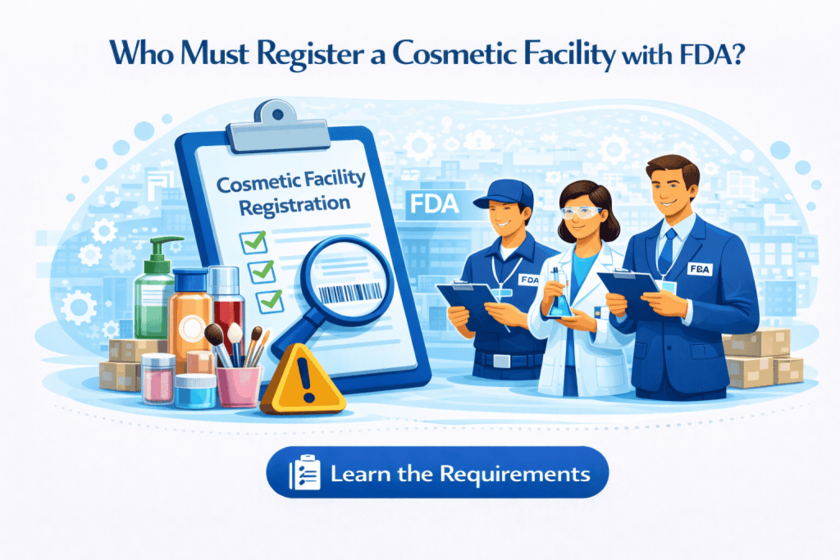
This guide explains exactly who must register, who is exempt (and what the precise small business threshold is), the difference between facility registration and product listing, the responsible person concept, annual renewal requirements, and the MoCRA obligations that apply even to exempt small businesses.
What MoCRA Is and Why It Changed Everything for Cosmetics
Who Must Register — and Who Is Exempt
| Entity Type | Must Register? | Notes |
|---|---|---|
| Domestic cosmetics manufacturer or processor | Required | Any U.S. facility manufacturing or processing cosmetics for U.S. distribution. Annual renewal October 1–December 31. |
| Foreign cosmetics manufacturer or processor | Required + U.S. Agent | Must register and designate a U.S. Agent with a physical U.S. address. FDA Registration Assistance provides U.S. Agent services. |
| Contract manufacturer (co-packer) | Required | The physical manufacturing location must register — regardless of whose name is on the product label. Brand then submits product listings referencing the contract manufacturer’s facility registration number. |
| Private label brand (responsible person) | Product Listing Required | If the brand’s name is on the label, they are the responsible person and must submit product listings. If the brand also owns the manufacturing facility, facility registration also required. |
| Repacker or relabeler | Evaluate Case-by-Case | Repackaging or relabeling may constitute processing — facility registration may be required. Evaluate the specific activity. |
| Small business below the revenue threshold | Facility Reg. Exempt | Average gross annual cosmetics sales in the U.S. under $1,000,000 (adjusted for inflation) over the prior 3-year period AND products do not contact mucous membrane of the eye AND no chemical/physical processing beyond simple mixing, coloring, or fragrancing. Still subject to: safety substantiation, adverse event reporting, and FDA inspection. |
| Retailer (sells finished cosmetics, no manufacturing) | Exempt | Retailers that purchase and resell finished cosmetics are not manufacturers. No facility registration required for the retail location. |
| Salon, spa, esthetician (applies purchased products) | Exempt | Purchasing and applying finished cosmetics is not manufacturing. Exempt. If the establishment also manufactures cosmetics for sale, that manufacturing activity requires evaluation. |
Two Separate MoCRA Obligations — What Each Covers
§ 607 — Cosmetic Facility Registration
Identifies: the physical facility — the location where cosmetics are manufactured or processed
Filed by: the owner or operator of the facility
Requires: facility name and address; owner/operator name; U.S. Agent designation (foreign facilities); product categories manufactured at the facility
Renewal: annually — October 1 through December 31 of each year
New facilities: within 60 days of first marketing or first engaging in manufacturing or processing
§ 608 — Cosmetic Product Listing
Identifies: the specific products manufactured at the registered facility
Filed by: the responsible person (the manufacturer, packer, or distributor whose name is on the label)
Requires: product name; responsible person name and address; facility registration number; product category; list of all cosmetic ingredients using INCI names
Annual update: July 1 through December 31 of each year
New products: within 120 days of first marketing
The Responsible Person Concept — Who Submits Product Listings
The responsible person under MoCRA is the manufacturer, packer, or distributor whose name appears on the cosmetic product label as required by Section 611 of the FD&C Act. For private label brands where a contract manufacturer makes the product but the brand’s name is on the label, the brand is the responsible person — not the contract manufacturer. The brand must submit product listings. The contract manufacturer registers the facility. Both have independent MoCRA obligations.
Who Qualifies for the Small Business Exemption from Facility Registration
The small business exemption under Section 607(a)(4) of the FD&C Act as amended by MoCRA exempts facilities from the facility registration requirement only if ALL of the following conditions are met simultaneously:
Conditions That Must Both Be Met
Revenue condition: Average gross annual sales in the United States of cosmetics — including sales of cosmetics from all affiliates — of less than $1,000,000 (adjusted for inflation) over the previous 3-year period.
Product condition: The facility does not manufacture or process cosmetics that (a) regularly come into contact with the mucous membrane of the eye (eye products, eye makeup removers), or (b) involve a chemical or physical process other than simple mixing, coloring, or fragrancing.
What the Exemption Does NOT Cover
Small businesses that qualify for the facility registration exemption are still subject to:
⚠ Safety substantiation — must be able to substantiate the safety of cosmetic products and ingredients
⚠ Serious adverse event reporting — must submit serious adverse event reports to FDA within 15 business days
⚠ 6-year record retention — for all adverse event records
⚠ FDA inspection authority — FDA may inspect even exempt facilities
Annual Registration Timeline and Key MoCRA Deadlines
Products That Are Both Cosmetics and Drugs
Some cosmetic products also meet FDA’s definition of an over-the-counter (OTC) drug because they make claims that go beyond cosmetic effects — or because FDA has determined they are drugs regardless of claims. These dual-use products require both MoCRA cosmetic compliance and drug establishment compliance:
Sunscreens
Regulated as an OTC drug AND a cosmetic. Requires: MoCRA facility registration + product listing; Drug Establishment Registration under 21 CFR Part 207; and the OTC drug monograph for sunscreens.
Anti-Dandruff Shampoos
Contains selenium sulfide, zinc pyrithione, or coal tar — regulated as OTC drugs. Requires drug establishment registration AND MoCRA cosmetic compliance.
Antiperspirants
Classified as OTC drugs (not just cosmetics) because they affect body function. Requires drug establishment registration under 21 CFR Part 207. Pure deodorants (no antiperspirant) are cosmetics only.
Fluoride Toothpaste
Regulated as an OTC drug AND a cosmetic. Drug establishment registration + MoCRA compliance both required. See the full guide: Is Toothpaste an OTC Drug?
Acne Products
Benzoyl peroxide, salicylic acid, and other acne-active ingredients make a product an OTC drug. Drug establishment registration AND MoCRA cosmetic compliance both required.
Hair Growth Products
Products making claims to promote hair growth or prevent hair loss are drugs (minoxidil is an approved drug ingredient). Require drug establishment registration. Hair care products without drug claims are cosmetics only.
Ready to Register Your Cosmetic Facility with FDA?
FDA Registration Assistance provides complete MoCRA compliance — cosmetic facility registration, product listing with INCI ingredient names, U.S. Agent designation for foreign facilities, annual renewal management, serious adverse event reporting guidance, and safety substantiation guidance. 1,000+ clients. 135+ countries. 15+ years of FDA regulatory experience.
Contact us at info@fdaregistrationassistance.com or call +1 (928) 275-8333.
Frequently Asked Questions — Who Must Register a Cosmetic Facility with FDA?
1. Who must register a cosmetic facility with FDA?
Under MoCRA (Modernization of Cosmetics Regulation Act of 2022), any person who owns or operates a facility that manufactures or processes a cosmetic product for distribution in the United States must register with FDA under Section 607 of the FD&C Act. Applies to both domestic and foreign facilities. Registration renews annually October 1–December 31.
2. What is MoCRA and when did it take effect?
MoCRA was signed into law December 29, 2022, as part of the Consolidated Appropriations Act of 2023. It is the most significant federal cosmetics legislation in over 85 years — the first law to impose mandatory facility registration, product listing, safety substantiation, and adverse event reporting requirements on cosmetics manufacturers at the federal level.
3. What is the difference between cosmetic facility registration and product listing?
Facility registration (Section 607) identifies WHERE cosmetics are made — filed by the facility owner/operator; renewed annually October 1–December 31. Product listing (Section 608) identifies WHAT products are made there — filed by the responsible person (the entity whose name is on the label) using INCI ingredient names; updated annually July 1–December 31. Both are required for covered facilities.
4. Who is the responsible person under MoCRA?
The responsible person is the manufacturer, packer, or distributor whose name appears on the cosmetic product label. For private label brands where a contract manufacturer makes the product but the brand’s name is on the label, the brand is the responsible person — not the contract manufacturer. The responsible person submits product listings, ensures safety substantiation, and submits serious adverse event reports.
5. Do contract manufacturers need to register their cosmetic facility?
Yes. The physical manufacturing facility must register — regardless of whose name is on the product label. If a brand hires a contract manufacturer, the contract manufacturer registers the facility, and the brand (as responsible person) submits product listings referencing the contract manufacturer’s facility registration number.
6. Do foreign cosmetic manufacturers need to register with FDA?
Yes. Foreign facilities manufacturing or processing cosmetics for U.S. distribution must register with FDA and designate a U.S. Agent with a physical U.S. address. The U.S. Agent’s name and contact information must be included in the registration submission. FDA Registration Assistance provides U.S. Agent services for foreign cosmetic facilities.
7. What is the small business exemption from cosmetic facility registration?
The exemption under Section 607(a)(4) requires ALL conditions to be met: average gross annual cosmetics sales in the U.S. under $1,000,000 (adjusted for inflation) over the prior 3-year period AND the facility does not make cosmetics that regularly contact the mucous membrane of the eye AND no chemical or physical processing beyond simple mixing, coloring, or fragrancing. Exempt businesses are still subject to safety substantiation, serious adverse event reporting, and FDA inspection.
8. Do brand owners need to register a cosmetic facility?
Brand owners do not register their office — facility registration applies to the physical manufacturing location. However, brands who are the responsible person (whose name is on the label) must submit product listings. If the brand also owns or operates the manufacturing facility, that facility must be registered by the brand.
9. What is the annual renewal requirement for cosmetic facility registration?
Cosmetic facility registration must be renewed annually — October 1 through December 31 of each year. This differs from FDA Food Facility Registration which renews biennially (every 2 years). Missing the annual renewal window results in the registration becoming inactive. New facilities must register within 60 days of first marketing.
10. What are the serious adverse event reporting requirements under MoCRA?
Responsible persons must submit serious adverse event reports to FDA within 15 business days of receiving them. A serious adverse event results in: death; a life-threatening experience; inpatient hospitalization; persistent or significant disability; congenital anomaly or birth defect; or an outcome requiring medical or surgical intervention. Adverse event records (serious and non-serious) must be retained for 6 years.
11. What products are considered cosmetics under MoCRA?
Cosmetics under 21 U.S.C. 321(i) are articles intended to be applied to the human body for cleansing, beautifying, promoting attractiveness, or altering appearance. Includes: skin care products, hair care products, makeup, nail products, perfumes, deodorants (not antiperspirants), and oral care products. Products that affect body structure or function are drugs — not cosmetics.
12. When are products both cosmetics and drugs?
Dual-use products requiring both MoCRA cosmetic compliance AND drug establishment registration: sunscreens; anti-dandruff shampoos (selenium sulfide, zinc pyrithione, coal tar); antiperspirants (OTC drugs — not cosmetics); fluoride toothpaste; acne products (benzoyl peroxide, salicylic acid); hair growth products making drug claims. Both obligations are separate and independent.
13. What information is required for cosmetic facility registration?
Facility name and address; owner or operator name; U.S. Agent name and contact information for foreign facilities; and the product categories manufactured or processed at the facility using FDA’s cosmetic product category list. Product listings (separate submission) additionally require: product name; responsible person information; facility registration number; and all cosmetic ingredients using INCI names.
14. What are INCI names and why are they required for product listing?
INCI names (International Nomenclature of Cosmetic Ingredients) are standardized international names for cosmetic ingredients established by the Personal Care Products Council. MoCRA requires INCI names for all ingredients in cosmetic product listings. INCI names provide a consistent, internationally recognized ingredient nomenclature across all manufacturers and countries.
15. What happens if a cosmetic facility is not registered with FDA?
Operating without required FDA registration violates the FD&C Act as amended by MoCRA. FDA may take enforcement action including Warning Letters, import refusals and detentions for foreign facilities, injunctive action, and seizure. Foreign cosmetic facilities whose products are not registered may have shipments refused entry at U.S. ports.
16. Do retailers need to register a cosmetic facility?
Retailers that purchase and resell finished cosmetics are not manufacturers — no facility registration required for the retail location. However, retailers operating private label programs (brand name on the label) are the responsible person and must submit product listings. Retailers who physically repackage cosmetics at their location may be engaging in processing that requires evaluation.
17. Do salon, spa, or esthetician facilities need to register?
Salons, spas, and esthetician facilities that purchase finished cosmetics and apply them to clients are not manufacturing — exempt from facility registration. If the establishment manufactures its own cosmetic products for sale or distribution, that manufacturing activity requires facility registration evaluation.
18. What is the U.S. Agent requirement for foreign cosmetic facilities?
Foreign cosmetic facilities must designate a U.S. Agent with a physical U.S. address as part of the facility registration. The U.S. Agent receives FDA communications on behalf of the foreign facility. FDA Registration Assistance provides U.S. Agent services for foreign cosmetic facilities.
19. How does cosmetic facility registration differ from food facility registration?
Key differences: food facility registration is under 21 U.S.C. 350d (21 CFR Part 1 Subpart H) and renews biennially; cosmetic facility registration is under Section 607 of the FD&C Act (MoCRA) and renews annually. Food facility registration does not require separate product listing; MoCRA requires separate product listing for each cosmetic product. MoCRA has a specific small business exemption; food facility registration does not.
20. Are safety substantiation requirements separate from facility registration?
Yes. Safety substantiation under Section 606 of the FD&C Act (MoCRA) is a separate obligation requiring responsible persons to ensure that cosmetic products and their ingredients are adequately substantiated for safety. This obligation applies to ALL responsible persons — including those whose facilities qualify for the small business registration exemption.
21. How does MoCRA affect private label cosmetics brands?
Private label brands — whose name appears on cosmetic labels though a contract manufacturer makes the product — are the responsible person under MoCRA. They must: submit product listings; ensure safety substantiation; submit serious adverse event reports within 15 business days; and maintain adverse event records for 6 years. The contract manufacturer registers the facility; the brand submits product listings.
22. What is the cosmetic product listing update requirement?
Product listings must be updated annually July 1 through December 31 to reflect any changes since the prior submission — including changes to product name, ingredients, responsible person information, or facility registration number. New products must be listed within 120 days of first marketing.
23. Does MoCRA apply to cosmetics sold online or on Amazon?
Yes. MoCRA applies to cosmetics distributed in the United States regardless of sales channel — retail, Amazon, eCommerce, or any other channel. Amazon and other major platforms may also require MoCRA compliance documentation from cosmetics sellers through their Consumer Product Compliance programs.
24. How does FDA Registration Assistance help with cosmetic facility registration?
Complete MoCRA compliance: facility registration submission; product listing preparation and submission with INCI ingredient names; U.S. Agent designation for foreign facilities; annual renewal management; serious adverse event reporting guidance; safety substantiation guidance. 1,000+ clients. 135+ countries. 15+ years of FDA regulatory experience.
25. How do I get started with cosmetic facility registration?
Contact FDA Registration Assistance at info@fdaregistrationassistance.com or call +1 (928) 275-8333. Provide your facility name and address, cosmetic products manufactured, the responsible person’s information, whether the facility is domestic or foreign, and any existing FDA registration information.