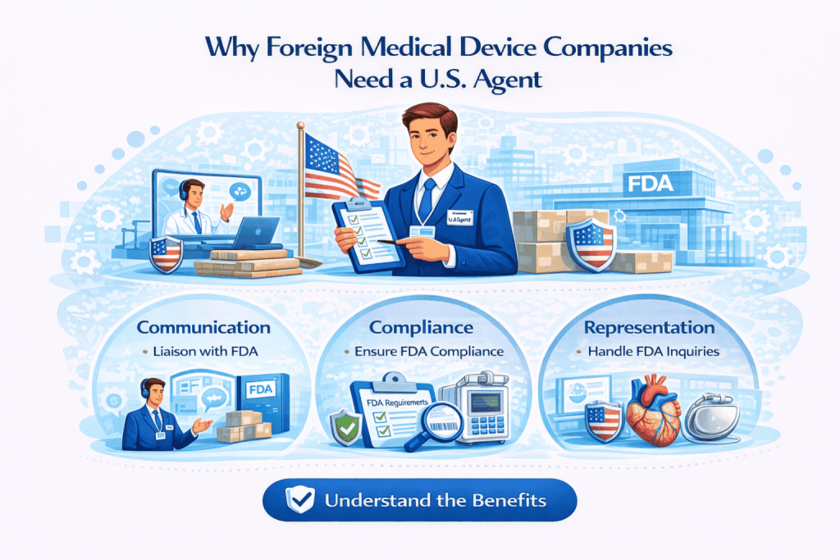
Why Foreign Medical Device Companies Need a U.S. Agent
Trusted by 1,000+ companies across 135+ countries, with 15+ years of FDA regulatory experience. Below: what the law requires, what the agent does and doesn't do, the roles it's confused with, and why device registration is annual.
What 21 CFR 807.40 Actually Requires
The requirement is short but specific. A foreign device establishment must name one U.S. Agent, and on the FDA's request that agent has three core duties:
What a U.S. Agent Does — and Doesn't Do
It Does
Act as the FDA's U.S. contact, assist communications and inspection scheduling, answer questions about your imported devices, and receive FDA documents on the establishment's behalf.
It Doesn't
Make a device FDA approved or cleared, replace a 510(k)/De Novo/PMA, act as your importer, fix non-compliant labeling, or take on quality-system, complaint, or adverse-event duties.
U.S. Agent vs the Roles It's Mistaken For
A single device supply chain can involve several U.S. parties. They are not interchangeable.
| Role | What it is | Key point |
|---|---|---|
| U.S. Agent (807.40) | The FDA's U.S. contact for the foreign establishment | Required to register; assists FDA communications & inspections |
| Official Correspondent | Facilitates registration & listing communication | A separate registration contact role |
| Initial Importer (807.3) | First U.S. recipient furthering the device's marketing | Has its own registration & listing duties |
| Importer of Record | Customs party responsible for the entry | A CBP role, not an FDA role |
Device Registration Is Annual — and Carries a Fee
This trips up companies used to the food rules. Food facility registration is free and renews every two years. Medical device establishment registration is different on both counts: it renews annually, during the FDA's October-to-December window, and it carries an annual establishment registration user fee that the FDA sets each fiscal year.
Your U.S. Agent designation has to stay accurate through every annual renewal — an outdated or unconfirmed agent is a common reason registrations lapse or stall.
What Happens Without a Proper U.S. Agent
Appoint a Reliable U.S. Agent — and Keep Registration Clean
We serve as the U.S. Agent for foreign medical device establishments and handle the surrounding work — establishment registration, device listing preparation, annual renewal, and importer coordination — so the FDA can always reach you and your records stay aligned. Email info@fdaregistrationassistance.com or call +1 (928) 275-8333.
Frequently Asked Questions — Medical Device U.S. Agent
Why do foreign medical device companies need a U.S. Agent?
Because 21 CFR 807.40 requires every foreign establishment that registers a device with the FDA to designate a U.S. Agent as the agency's U.S.-based point of contact. Without one, the establishment can't complete registration or legally import its devices.
What's the legal basis for the requirement?
It comes from section 510 of the FD&C Act and 21 CFR 807.40, which govern establishment registration and device listing for foreign device establishments importing or offering devices for import into the United States.
What does a device U.S. Agent actually do?
On the FDA's request, the U.S. Agent assists the agency in communicating with the foreign establishment, answers questions about its imported devices, and helps schedule inspections of the foreign facility. It is fundamentally a communication role.
What is “deemed delivery”?
If the FDA can't reach the foreign establishment directly or quickly, it may send information or documents to the U.S. Agent, and under 807.40 that is treated as equivalent to delivering them to the foreign establishment. Responsiveness matters.
Who needs a U.S. Agent?
Foreign manufacturers, contract manufacturers, specification developers, sterilizers, relabelers, repackagers, and other foreign establishments that must register a device with the FDA. The requirement follows the duty to register.
Does a U.S. Agent make my device FDA approved or cleared?
No. The U.S. Agent designation is a registration requirement only. Your device may still need classification, listing, and a 510(k), De Novo, or PMA, plus labeling and quality-system compliance, depending on the device.
Is the U.S. Agent the same as an Initial Importer?
No. The Initial Importer, defined in 21 CFR 807.3, is the U.S. establishment that first receives the device and furthers its marketing, with its own registration and listing duties. The U.S. Agent is the FDA's communication contact.
Is the U.S. Agent the same as the Official Correspondent?
No. The Official Correspondent facilitates registration and listing communication for the establishment, while the U.S. Agent is the FDA's designated U.S. contact for the foreign establishment. They are separate roles that can be different people.
Is the U.S. Agent the same as the importer of record?
No. The importer of record is a U.S. Customs party responsible for entry filings and duties. The U.S. Agent is an FDA role. One supply chain can involve a U.S. Agent, an importer of record, a broker, and a distributor.
Where must the U.S. Agent be located?
In the United States, with a real physical U.S. address — a PO box is not acceptable — and reachable during U.S. business hours. A foreign address or an unreachable contact cannot serve as the U.S. Agent.
How many U.S. Agents can a foreign establishment have?
One. Each foreign device establishment designates a single U.S. Agent in the FDA's electronic device registration and listing system as its point of contact with the agency.
How quickly must U.S. Agent changes be reported?
Within 10 business days. The foreign establishment or the U.S. Agent must report any change in the U.S. Agent's name, address, or phone number to the FDA within 10 business days of the change.
Does the U.S. Agent have to confirm the designation?
Yes. The named U.S. Agent must confirm the appointment in the FDA's system, generally within 10 business days, or the system can cancel the designation and stall the establishment's registration.
Can our U.S. distributor be our U.S. Agent?
Sometimes, but it can be risky. A distributor may not track FDA communications, renewals, or listing issues, and if the relationship ends you may need to change agents quickly. Many firms prefer an independent, compliance-focused agent.
Can our customs broker be our U.S. Agent?
A broker isn't automatically a suitable FDA U.S. Agent. Brokers focus on customs entry, not ongoing FDA registration communication, renewals, and listing. The U.S. Agent role calls for FDA-registration familiarity.
Can the FDA contact the U.S. Agent instead of us?
Yes. The FDA may route communications to the U.S. Agent, which is exactly why responsiveness matters. A U.S. Agent that doesn't monitor messages can delay inspections, questions, and other regulatory matters.
Does the U.S. Agent take on liability for our device?
No. The U.S. Agent doesn't submit your premarket applications, handle adverse-event reporting, or assume legal responsibility for the device. Those duties stay with the manufacturer and other responsible parties.
Is device registration annual or biennial?
Annual. Unlike food facilities, which renew every two years, medical device establishment registration is renewed each year during the FDA's October-to-December window, and the U.S. Agent must remain current at renewal.
Is there a fee for device registration?
Yes. Device establishment registration carries an annual user fee set by the FDA each fiscal year, separate from any U.S. Agent service fee. Food facility registration, by contrast, is free.
What happens if we don't have a U.S. Agent?
A foreign establishment generally can't complete or maintain FDA registration without one, so its devices can't be legally imported and entries can be held or refused.
When should we appoint a U.S. Agent?
Before submitting establishment registration, before finalizing device listing, and before shipping devices or samples to the U.S. Appointing early keeps registration, listing, and import details aligned from the start.
Do we need a U.S. Agent just to ship samples?
Likely yes, if the item is a regulated device and the establishment must register. Being small, promotional, or for evaluation doesn't automatically remove FDA requirements; the intended use and import purpose should be reviewed.
Does the U.S. Agent appear on the device label?
Not automatically. Labeling — including manufacturer and distributor information and UDI — is governed separately. The U.S. Agent's role doesn't replace required labeling, which should be reviewed on its own.
Can we change our U.S. Agent later?
Yes. You can change agents, but update the FDA records carefully and within the 10-business-day window, ideally before a renewal, import, or FDA communication makes the change urgent.
Can FDA Registration Assistance act as our U.S. Agent?
Yes. We serve as the U.S. Agent for foreign device establishments and support registration, listing, renewal, and importer coordination. Contact us — info@fdaregistrationassistance.com or +1 (928) 275-8333.
Why Foreign Medical Device Companies Need a U.S. Agent
Foreign medical device companies that register with FDA generally need a U.S. Agent to serve as the official U.S. contact for FDA communications, registration matters, device listing coordination, import questions, renewal support, and regulatory contact readiness.
Quick Facts
Medical Device U.S. Agent Requirements at a Glance
Introduction
Why the U.S. Agent Role Matters for Foreign Device Companies
Foreign medical device companies often focus on manufacturing, pricing, distributors, shipping, and FDA registration numbers, but the U.S. Agent role is one of the most important compliance details in the registration process. The U.S. Agent is the designated U.S. contact for FDA communications involving the foreign establishment. This role helps FDA communicate efficiently with companies located outside the United States.
For a foreign medical device manufacturer, contract manufacturer, specification developer, sterilizer, relabeler, repackager, or other registered establishment, the U.S. Agent designation is not just a formality. It can affect how quickly FDA communications are received, how registration issues are addressed, how import-related questions are routed, and how confidently buyers or distributors view the company’s U.S. compliance readiness.
A U.S. Agent does not make a device FDA approved, cleared, or authorized. FDA establishment registration and U.S. Agent designation are not substitutes for device classification, device listing, 510(k), De Novo, PMA, labeling compliance, quality system requirements, or import compliance. However, without a proper U.S. Agent, a foreign company may not be able to maintain the correct FDA registration structure for U.S. market access.
This guide explains why foreign medical device companies need a U.S. Agent, what the role does, what it does not do, how it connects with registration and device listing, and why choosing the right U.S. Agent can reduce preventable compliance problems.
Core Educational Guide
What Is a Medical Device U.S. Agent?
A medical device U.S. Agent is a person or business located in the United States that is designated by a foreign medical device establishment to assist FDA in communications with that foreign establishment. The U.S. Agent helps FDA contact the foreign company, supports communication related to registration matters, and may assist with questions that arise from FDA records or import activity.
The U.S. Agent Is a Contact Point
The U.S. Agent is primarily a communication contact for FDA. FDA may use the U.S. Agent when it needs to contact the foreign establishment about registration, listing, inspections, import questions, or other regulatory matters. A reliable U.S. Agent should be responsive and organized because delayed communications can create avoidable business risk.
The U.S. Agent Is Not FDA Approval
A U.S. Agent designation does not mean FDA has approved the company or the device. It does not replace device classification, registration, listing, 510(k), De Novo, PMA, quality system compliance, labeling compliance, or importer obligations. The U.S. Agent is one part of a larger medical device compliance structure.
Who Needs a Medical Device U.S. Agent?
Foreign medical device establishments that are required to register with FDA generally need to designate a U.S. Agent. The requirement is tied to the foreign establishment’s FDA registration obligations and regulated activity. A foreign company should review its role in the medical device supply chain before assuming whether the U.S. Agent requirement applies.
Foreign Establishments That May Need a U.S. Agent
Role Analysis Comes First
A foreign business should identify whether it is the manufacturer, contract manufacturer, specification developer, exporter, private label owner, or another regulated establishment type. This role analysis affects registration, listing, importer details, product code selection, and whether the U.S. Agent designation is required.
What a U.S. Agent Does for FDA Medical Device Registration
The U.S. Agent helps connect the foreign establishment with FDA for official communication purposes. In practical business terms, a qualified U.S. Agent can also help the foreign company understand registration timing, annual renewal expectations, device listing coordination, importer information, and documentation requests from U.S. buyers or brokers.
What a U.S. Agent Does Not Do
Many companies misunderstand the U.S. Agent role. A U.S. Agent is important, but it does not automatically solve every FDA requirement. Foreign device companies must still review device classification, product code, premarket pathway, labeling, registration, listing, quality system duties, importer responsibilities, and import documentation.
Comparison Table: Good U.S. Agent vs Poor U.S. Agent
| Compliance Area | Good U.S. Agent Support | Poor or Risky U.S. Agent Setup |
|---|---|---|
| FDA Communications | Receives, recognizes, and routes FDA communications promptly to the foreign establishment. | Misses messages, delays responses, or does not understand the regulatory importance of FDA contact. |
| Registration Setup | Helps the foreign company understand U.S. Agent designation and registration coordination. | Provides a name and address but gives little support when registration questions arise. |
| Device Listing Awareness | Understands that device listing, product codes, and establishment roles must align with registration records. | Assumes the U.S. Agent role alone is enough without reviewing device listing implications. |
| Import Readiness | Helps foreign companies understand that FDA records, importer information, labels, and entry data should be consistent. | Does not help address importer or broker questions related to FDA records. |
| Renewals | Supports annual renewal planning and keeps contact information current. | Lets registration details become outdated, inactive, or difficult to verify. |
| Business Confidence | Provides a professional U.S.-based compliance contact that distributors and buyers can recognize. | Creates confusion when buyers, brokers, or FDA need reliable U.S. contact information. |
How the U.S. Agent Connects to FDA Registration and Device Listing
Foreign medical device companies often need FDA establishment registration and device listing before commercial distribution in the United States. The U.S. Agent designation is part of the foreign establishment’s FDA registration structure. The device listing then connects the establishment to the devices it manufactures, processes, imports, or otherwise handles.
Registration Connection
During FDA registration, the foreign establishment identifies its establishment information, activities, official contacts, and U.S. Agent. The U.S. Agent must be properly designated so FDA has a U.S.-based contact for the foreign establishment.
Listing Connection
Device listing should align with the company’s actual device, product code, classification, establishment activity, and premarket status. A U.S. Agent does not choose the product code alone, but a knowledgeable compliance partner can help identify issues before inaccurate listing information creates downstream problems.
Key Compliance Section
Legal Authority and Official FDA Sources
FDA medical device U.S. Agent requirements are connected to FDA establishment registration and device listing regulations. Foreign establishments that register with FDA must provide required establishment information and maintain accurate records. FDA uses the U.S. Agent as a U.S.-based communication contact for the foreign establishment.
Medical device establishment registration and listing requirements are addressed in 21 CFR Part 807. Medical device regulations appear in 21 CFR Subchapter H. FDA also provides official resources for Device Registration and Listing, Who Must Register, List and Pay the Fee, and Importing Medical Devices into the United States.
Foreign companies should understand that U.S. Agent designation does not remove obligations under the FD&C Act, 21 CFR medical device regulations, device classification rules, quality system requirements, labeling rules, premarket submission requirements, or FDA import authority. FDA may take action when devices appear misbranded, adulterated, improperly listed, improperly cleared, or otherwise non-compliant.
Real-World Risks of Not Having the Right U.S. Agent
Common U.S. Agent Mistakes Foreign Device Companies Make
Foreign medical device companies often treat the U.S. Agent role as an address requirement instead of a compliance communication role. This can create problems when FDA, importers, brokers, distributors, or marketplaces ask for timely information. A U.S. Agent should be reliable, reachable, and familiar with FDA registration expectations.
Documentation Mistakes
Strategy Mistakes
When Should a Foreign Device Company Appoint a U.S. Agent?
A foreign medical device company should appoint a U.S. Agent before completing FDA establishment registration and before offering devices for import into the United States. The company should not wait until a shipment is already in transit or until a distributor requests proof of FDA registration. Early U.S. Agent appointment helps align registration, listing, importer information, and communication readiness.
Medical Device U.S. Agent Services for Foreign Companies
FDA Registration Assistance is a U.S.-based FDA compliance consulting firm located in Miami, Florida. We help foreign medical device companies appoint a U.S. Agent, complete FDA establishment registration, prepare device listing information, coordinate importer details, understand classification issues, and maintain annual registration readiness.
Our team has assisted more than 1,000 companies in over 135 countries with FDA registration and regulatory compliance matters. With 15+ years of combined experience, we support manufacturers, foreign exporters, importers, distributors, specification developers, and private label device companies preparing to sell or import medical devices in the United States.
Contact FDA Registration Assistance at info@fdaregistrationassistance.com or visit https://www.fdaregistrationassistance.com/.
Frequently Asked Questions
Medical Device U.S. Agent FAQs
These FAQs answer common questions foreign medical device companies ask about U.S. Agent requirements, FDA registration, device listing, imports, renewals, and U.S. market entry.
1. Why do foreign medical device companies need a U.S. Agent?
Foreign medical device companies that register with FDA generally need a U.S. Agent because FDA requires a U.S.-based communication contact for foreign establishments. The U.S. Agent helps FDA communicate with the foreign company about registration, listing, inspections, import issues, and other regulatory matters. This requirement helps FDA reach foreign establishments more efficiently when questions or compliance issues arise.
2. Is a U.S. Agent required for every foreign medical device company?
A U.S. Agent is generally required for foreign medical device establishments that must register with FDA. Whether a company must register depends on its role in the device supply chain. Manufacturers, contract manufacturers, specification developers, sterilizers, relabelers, repackagers, and other foreign establishments may have registration obligations. The company’s specific activities should be reviewed before determining the requirement.
3. What does a medical device U.S. Agent do?
A medical device U.S. Agent serves as the U.S. contact for FDA communications involving the foreign establishment. The U.S. Agent may assist FDA in contacting the company, help route official communications, support registration coordination, and help foreign companies remain aware of registration and renewal responsibilities. A strong U.S. Agent provides responsive communication and practical support when FDA-related questions arise.
4. Does a U.S. Agent make my medical device FDA approved?
No. A U.S. Agent does not make a device FDA approved, cleared, certified, authorized, or endorsed. U.S. Agent designation is a registration-related requirement for foreign establishments. The device may still need classification review, device listing, 510(k) clearance, De Novo authorization, PMA approval, compliant labeling, quality system controls, and import compliance depending on the device and intended use.
5. Is a U.S. Agent the same as an initial importer?
No. A U.S. Agent is not the same as an initial importer. The U.S. Agent is a U.S.-based communication contact for FDA. The initial importer is generally the establishment that furthers the marketing of a device from a foreign manufacturer to the person who makes final delivery or sale to the ultimate consumer or user. These roles should not be confused because they carry different responsibilities.
6. Is a U.S. Agent the same as an importer of record?
No. The importer of record is a customs-related party responsible for entry matters with U.S. Customs and Border Protection. The U.S. Agent is an FDA communication contact for the foreign establishment. A company may have a U.S. Agent, an initial importer, a customs broker, an importer of record, a distributor, and a buyer involved in the same supply chain, but each role is different.
7. Can our U.S. distributor act as our U.S. Agent?
A U.S. distributor may be able to act as a U.S. Agent in some cases, but foreign companies should be careful. A distributor may not understand FDA communications, registration renewals, device listing issues, or regulatory response expectations. If the distributor relationship ends or becomes strained, the foreign establishment may need to update its U.S. Agent quickly. Many companies prefer an independent compliance-focused U.S. Agent.
8. Can our customs broker act as our U.S. Agent?
A customs broker is not automatically a proper FDA U.S. Agent for medical device registration. Brokers usually focus on customs entry filings and shipment clearance, not ongoing FDA establishment registration communication. A foreign device company should choose a U.S. Agent that understands FDA registration, device listing, annual renewal, and regulatory communication expectations.
9. Can FDA contact the U.S. Agent instead of the foreign manufacturer?
Yes. FDA may contact the U.S. Agent to help communicate with the foreign establishment. This is one reason responsiveness matters. If the U.S. Agent does not monitor communications or cannot reach the foreign company, regulatory matters may be delayed. A reliable U.S. Agent should be able to route FDA communications quickly and professionally.
10. What information is needed to appoint a medical device U.S. Agent?
The foreign establishment typically needs its legal company name, physical facility address, contact person, email, phone number, establishment role, device information, and FDA registration-related details. The U.S. Agent must also provide accurate U.S. contact information. Additional information may be needed if the company is completing FDA registration, device listing, classification review, or renewal at the same time.
11. Does U.S. Agent service include FDA registration?
U.S. Agent service and FDA registration are related but not the same. Some providers offer only U.S. Agent designation, while others support both U.S. Agent service and FDA establishment registration. FDA Registration Assistance can support foreign medical device companies with U.S. Agent service, registration coordination, device listing preparation, renewal support, and related compliance guidance.
12. Does U.S. Agent service include device listing?
A U.S. Agent designation alone does not automatically complete device listing. Device listing requires accurate device-specific information such as product code, regulation number, classification, activity, and premarket status when applicable. Foreign companies should treat device listing as a separate compliance step that must align with the registration and actual device being marketed.
13. Does a U.S. Agent review device classification?
The U.S. Agent role itself is not the same as a full classification review. However, a qualified FDA compliance firm acting as U.S. Agent may also help identify classification concerns, product code issues, registration gaps, or premarket pathway questions. This is one reason many foreign device companies choose a compliance-focused U.S. Agent instead of a general mail contact.
14. What happens if a foreign device company has no U.S. Agent?
A foreign device establishment that is required to register with FDA may not be able to properly maintain its registration without a U.S. Agent. This can create problems with FDA communications, registration status, import review, buyer documentation requests, and annual renewal. If devices are shipped into the United States without proper records, the company may face delays or compliance questions.
15. Can a foreign company change its U.S. Agent?
Yes. A foreign medical device company can change its U.S. Agent, but the update should be handled carefully so FDA records remain accurate. Companies often change U.S. Agents when the current agent is unresponsive, too expensive, not compliance-focused, or no longer suitable. The company should make the change before renewals, import activity, or FDA communications create urgency.
16. How often should U.S. Agent information be reviewed?
U.S. Agent information should be reviewed at least annually during FDA medical device registration renewal and whenever there is a change in contact details, company ownership, facility address, distributor relationship, or U.S. market strategy. Accurate U.S. Agent information helps prevent communication delays and supports registration integrity.
17. Does a U.S. Agent help with FDA import delays?
A U.S. Agent may help route FDA communications and clarify registration-related information, but the U.S. Agent does not guarantee import release. Import delays may involve device classification, listing, product code, labeling, manufacturer registration, entry data, or admissibility concerns. A compliance-focused U.S. Agent can help foreign companies understand what records should be aligned before shipment.
18. Do foreign companies need a U.S. Agent before shipping samples?
If the foreign establishment is required to register and the product is a regulated medical device, U.S. Agent and registration questions should be reviewed before shipping samples. The fact that a shipment is small, promotional, or for evaluation does not automatically remove FDA requirements. The intended use, device classification, import purpose, and shipment documentation should be reviewed before export.
19. Can a U.S. Agent be outside the United States?
No. The purpose of the U.S. Agent role is to provide FDA with a contact located in the United States. A foreign company should not list a foreign address or unavailable contact as its U.S. Agent. The U.S. Agent should have reliable U.S. contact details and be capable of receiving and routing FDA communications.
20. Does the U.S. Agent need to be listed on the product label?
The U.S. Agent is not automatically required to appear on the product label simply because it serves as the FDA U.S. Agent. Medical device labeling must be reviewed separately based on the device, manufacturer, distributor, intended use, UDI requirements, and applicable labeling regulations. Companies should not assume the U.S. Agent’s name replaces required manufacturer or distributor labeling information.
21. Does a U.S. Agent handle annual FDA medical device renewal?
A U.S. Agent may assist with renewal coordination depending on the service agreement. FDA medical device establishment registration generally requires annual renewal. Foreign companies should make sure their U.S. Agent or compliance provider is prepared to help maintain accurate records, update contact information, and support renewal timing so registration does not lapse.
22. What should foreign companies look for in a U.S. Agent?
Foreign companies should look for a U.S.-based agent that is responsive, familiar with FDA medical device registration, understands device listing issues, can communicate clearly, supports renewal planning, and can help identify compliance risks. A low-cost or informal contact may seem convenient, but poor responsiveness can create problems when FDA or a buyer needs information quickly.
23. Can FDA Registration Assistance act as our U.S. Agent?
Yes. FDA Registration Assistance provides U.S. Agent services for foreign medical device companies. We support foreign establishments with U.S. Agent designation, FDA registration coordination, device listing preparation, renewal support, importer-related questions, and practical compliance guidance for U.S. market entry. Our team is based in the United States and works with companies worldwide.
24. When should a foreign company appoint a U.S. Agent?
A foreign medical device company should appoint a U.S. Agent before completing FDA registration, before listing devices, before shipping products to the United States, and before U.S. distributors or marketplaces request compliance documents. Waiting until a shipment is already moving can make corrections more difficult and increase the risk of delays.
25. Why use FDA Registration Assistance instead of a general contact?
FDA Registration Assistance is a U.S.-based FDA compliance consulting firm that understands medical device registration, U.S. Agent designation, device listing, importer coordination, classification concerns, and renewal timing. We have assisted more than 1,000 companies in over 135 countries and provide professional support for foreign device companies entering or maintaining access to the U.S. market.