The Food Safety Modernization Act (FSMA)
Represents a fundamental shift in how food safety is regulated in the United States. Rather than relying on outbreak response and enforcement after contamination occurs, FSMA requires food businesses to establish preventive, documented, and continuously monitored food safety systems designed to identify hazards before they cause harm.
FSMA applies to nearly every company that manufactures, processes, packs, holds, distributes, or imports food for human or animal consumption in the U.S. market — including domestic facilities and foreign exporters.
At FDA Registration Assistance LLC, we provide comprehensive FSMA compliance services, helping companies build FDA-approved food safety systems that meet regulatory requirements while supporting efficient operations and long-term market access.
Failure to comply with FSMA can result in FDA enforcement actions such as product detention, import refusals, facility registration suspension, mandatory recalls, and placement on Import Alert.
Why FSMA Transformed Food Safety Regulation
Before FSMA, FDA’s regulatory framework focused heavily on responding to foodborne illness outbreaks after consumers were harmed. FSMA introduced a prevention-based approach requiring food companies to proactively manage safety risks.
FSMA expanded FDA’s authority to:
Conduct frequent risk-based inspections
Access food safety records on demand
Block unsafe food imports
Order mandatory recalls
Suspend facility registrations
Enforce supply chain accountability
The law recognizes that modern food supply chains are global and complex, requiring preventive systems rather than reactive enforcement.
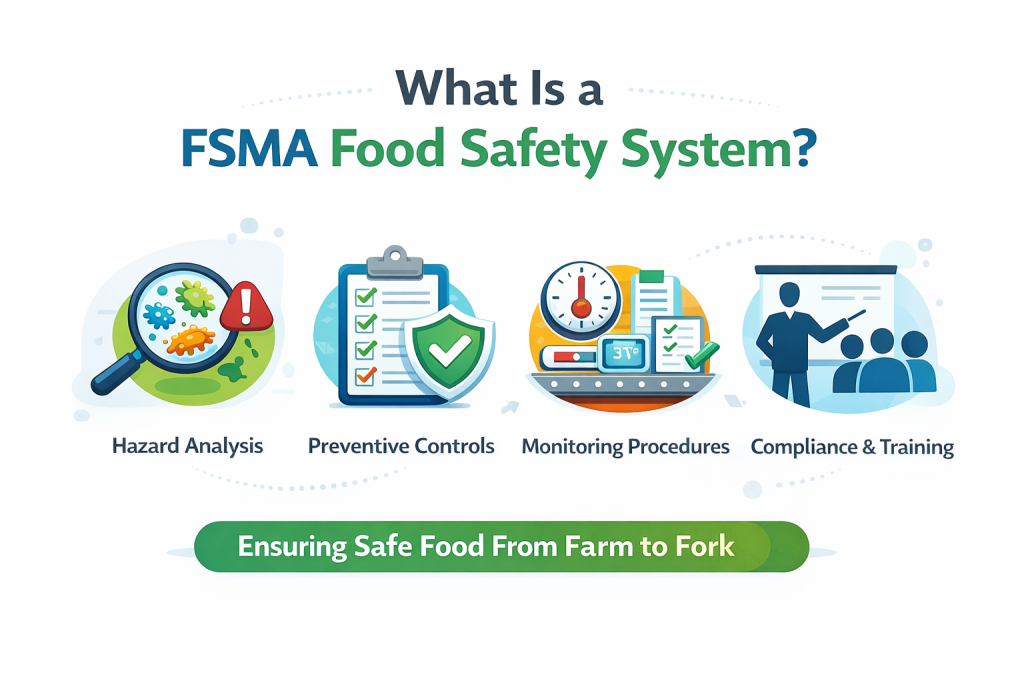
What Is a FSMA Food Safety System?
A FSMA food safety system is a formal, written, science-based program that evaluates risks and implements controls across all stages of food production and distribution.
It is centered on a Food Safety Plan which includes:
Comprehensive hazard analysis
Preventive controls addressing identified risks
Monitoring procedures to ensure controls function properly
Verification activities to confirm system effectiveness
Corrective actions when deviations occur
Supplier verification and approval processes
Product recall procedures
Detailed recordkeeping and documentation
Each system must be tailored to the specific facility, products, ingredients, and operational risks.
Core FSMA Compliance Elements in Detail
Hazard Analysis
Facilities must systematically analyze every step of production — from raw material receiving through processing, packaging, storage, and shipping — to identify:
• Microbiological risks such as Salmonella, Listeria, E. coli
• Chemical hazards including allergens, toxins, residues, and contaminants
• Physical hazards like metal fragments, glass, and foreign objects
This analysis forms the foundation of all preventive controls.
Preventive Controls
Preventive controls are risk-based measures implemented to prevent or significantly reduce hazards, including:
Process controls such as temperature monitoring, cooking steps, and formulation limits
Allergen management systems to prevent cross-contact
Sanitation procedures for equipment and facilities
Supply chain controls requiring approved suppliers and verification activities
Food defense strategies protecting against intentional adulteration
Monitoring, Verification, and Validation
FSMA requires active oversight of food safety systems, including:
Routine monitoring of controls
Verification through testing, audits, and record reviews
Validation proving controls effectively manage hazards
Corrective Actions
If monitoring shows a failure, companies must document corrective actions such as product disposition, process changes, retraining, or system modifications.
Recordkeeping
Records are legally required and must be readily accessible to FDA investigators during inspections.
FSMA Regulations That May Apply to Your Operation
Many businesses fall under multiple FSMA rules, including:
Preventive Controls for Human Food
Preventive Controls for Animal Food
Foreign Supplier Verification Program (FSVP)
Produce Safety Rule
Sanitary Transportation Rule
Intentional Adulteration Rule
Food Traceability Rule
Understanding which apply is essential for compliance.
Industries and Businesses Covered Under FSMA
FSMA impacts:
Food manufacturers and processors
Dietary supplement producers
Co-packers and contract manufacturers
Food storage warehouses and cold storage facilities
Private label food brands
Food importers and exporters
Distributors and logistics providers
Both U.S. and Foreign Facilities supplying the U.S. market must comply.
How FDA Registration Assistance LLC Supports FSMA Compliance
We provide end-to-end FSMA compliance services including:
Custom Food Safety Plans
Hazard analysis development
Preventive controls implementation
FSVP programs for importers
Supplier verification systems
HACCP integration
Inspection readiness preparation
Ongoing regulatory compliance support
Our approach ensures systems are practical, defensible, and inspection-ready.
FSMA & Food Safety Systems – Frequently Asked Questions
1. What is FSMA and why was it created?
FSMA is a U.S. federal law designed to modernize food safety regulation by focusing on prevention rather than response. It was created to reduce foodborne illness by requiring food companies to proactively identify hazards and implement systems that prevent contamination before products reach consumers.
2. Who is required to comply with FSMA regulations?
FSMA applies to most companies that manufacture, process, pack, hold, distribute, or import food for human or animal consumption in the United States. This includes domestic facilities and foreign exporters supplying the U.S. market.
3. Does FSMA apply to foreign food manufacturers?
Yes. Foreign facilities that export food to the U.S. must comply with FSMA requirements and are subject to FDA inspections and enforcement actions.
4. What is a FSMA Food Safety Plan?
A Food Safety Plan is a written document that identifies potential hazards and establishes preventive controls, monitoring procedures, verification activities, corrective actions, and recordkeeping systems to ensure food safety.
5. Are small businesses exempt from FSMA?
Some very small businesses qualify for modified requirements, but most food facilities still must implement basic FSMA compliance systems and documentation.
6. How is FSMA different from HACCP?
HACCP focuses primarily on process controls, while FSMA requires broader preventive controls including allergens, sanitation, supply chain oversight, and formal documentation systems.
7. What hazards must be evaluated under FSMA?
Facilities must analyze biological hazards such as pathogens, chemical hazards including allergens and residues, and physical hazards such as metal or glass contamination.
8. What happens if a company fails FSMA compliance?
FDA may issue warning letters, detain products, refuse imports, suspend facility registrations, mandate recalls, or place companies on Import Alert.
9. How often does FDA conduct FSMA inspections?
Inspection frequency is risk-based and can range from annually for high-risk facilities to every several years for lower-risk operations.
10. Are warehouses required to comply with FSMA?
Yes. Facilities that hold food products subject to FSMA must implement appropriate food safety systems.
11. Does FSMA apply to dietary supplements?
Yes. Most dietary supplement manufacturers and processors fall under FSMA preventive controls requirements.
12. What is the Foreign Supplier Verification Program (FSVP)?
FSVP requires U.S. importers to verify that foreign suppliers produce food in compliance with U.S. safety standards.
13. Who is responsible for FSVP compliance?
The U.S. importer of record is legally responsible for maintaining FSVP documentation and verification.
14. Are employee training programs required under FSMA?
Yes. Personnel involved in food safety must be properly trained and qualified.
15. How long must FSMA records be kept?
Most records must be retained for at least two years and be accessible during FDA inspections.
16. Is a product recall plan required?
Yes. Facilities must maintain a written recall plan outlining how unsafe products will be removed from the market.
17. Does FSMA apply to animal food?
Yes. Separate preventive controls regulations exist for animal food facilities.
18. Is sanitation a formal FSMA requirement?
Yes. Sanitation preventive controls are required where contamination risks exist.
19. Can FDA request records without warning?
Yes. FDA has authority to access food safety records during inspections.
20. Is FSMA a one-time compliance effort?
No. FSMA requires continuous monitoring, updates, training, and system maintenance.
21. Are private label brands responsible for FSMA compliance?
Yes. Brand owners share responsibility depending on their role in the supply chain.
22. Are beverages covered under FSMA?
Yes. Most beverages regulated by FDA fall under FSMA requirements.
23. Does FSMA include allergen controls?
Yes. Allergen management is a major component of preventive controls.
24. Does FSMA require food traceability?
Yes. Certain high-risk foods must meet enhanced traceability requirements.
25. Can FDA stop food shipments for FSMA violations?
Yes. FDA can detain, refuse, or seize products.
26. Are organic foods exempt from FSMA?
No. Organic products must meet FSMA requirements.
27. Does FSMA apply to online food sellers?
Yes. Food sold online that enters U.S. commerce must comply.
28. Can FDA inspect foreign facilities?
Yes. FDA conducts inspections worldwide.
29. Do co-packers need FSMA systems?
Yes. Contract manufacturers are fully subject to FSMA.
30. Is supplier verification mandatory?
Yes. Many operations must verify supplier safety practices.
31. Does FSMA require testing programs?
Some facilities must implement environmental and product testing.
32. Are corrective actions mandatory?
Yes. Deviations must be corrected and documented.
33. Can FSMA rules change?
Yes. FDA updates guidance and enforcement policies regularly.
34. Is FSMA compliance expensive?
Costs vary, but prevention systems are far less costly than enforcement actions.
35. How can businesses ensure full compliance?
By implementing customized food safety systems and maintaining ongoing oversight.
36. Does FSMA replace FDA registration?
No. Food Facility Registration remains required.
37. Is food defense part of FSMA?
Yes. Intentional adulteration protections are required.
38. Are logistics companies impacted?
Yes, particularly under the Sanitary Transportation Rule.
39. Must food safety plans be reviewed?
Yes, at least every three years or when changes occur.
40. Can FDA Registration Assistance help implement FSMA systems?
Yes. We provide complete FSMA compliance solutions from planning to inspections.
Begin Your FSMA Compliance With Confidence
FSMA compliance protects your customers, your brand, and your access to the U.S. market.
FDA Registration Assistance LLC offers complete food safety system development, implementation, and long-term compliance support.
📞 Contact us today to speak with an FSMA compliance expert. Contact us directly by email at info@fdaregistrationassistance.com OR Phone: +1 (928) 275-8333